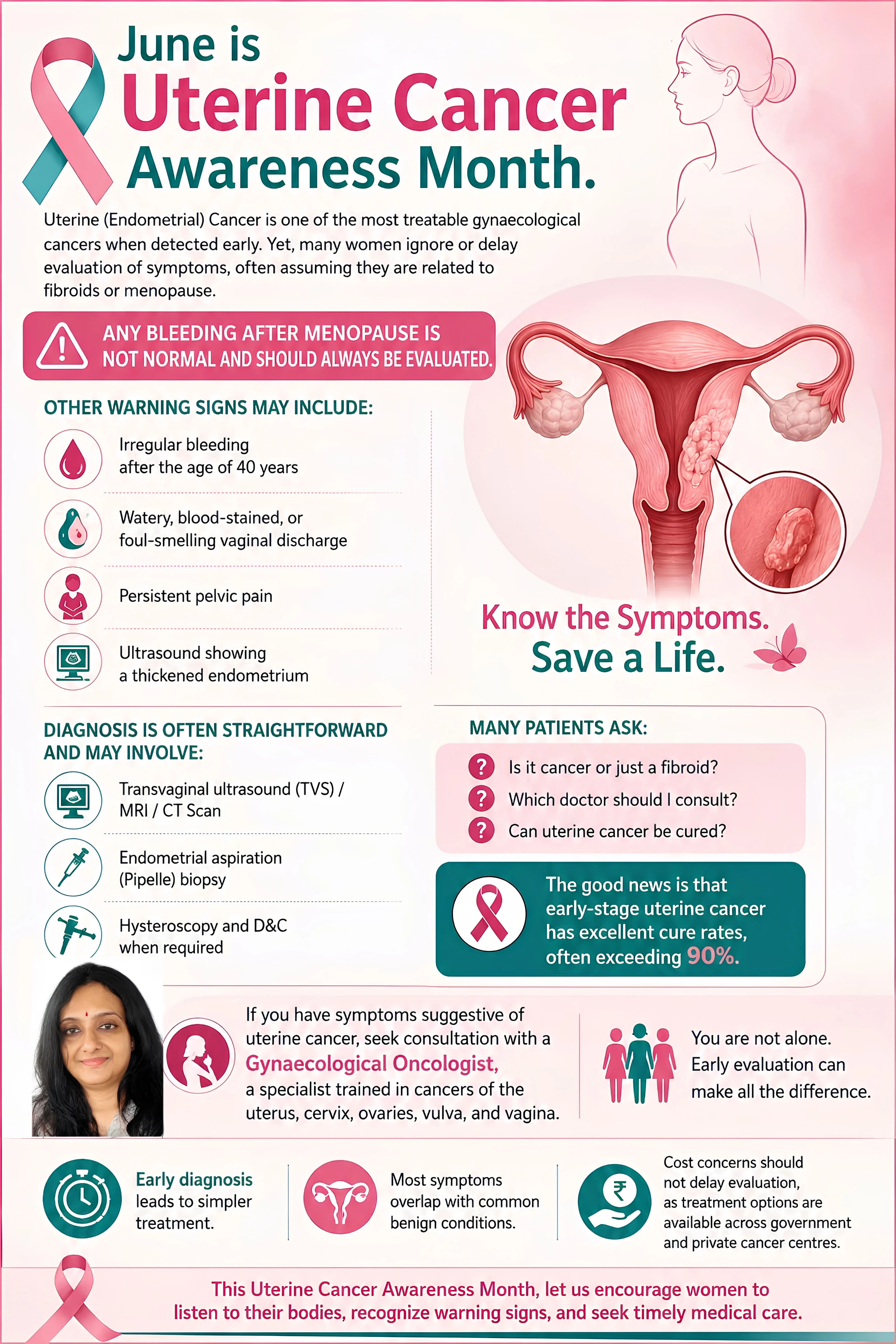
Uterine cancer — most commonly endometrial cancer — is one of the most treatable gynaecological cancers when detected early.[1] Yet many women struggle with the same questions: is this cancer or just a fibroid? Which doctor should I see? Can it actually be cured?
This guide answers the most common real questions patients ask, in plain, practical language.
Any bleeding after menopause is not normal and should always be evaluated — even a small amount of spotting.
Who Is the Right Doctor for Uterine Cancer?
The right specialist for uterine cancer is a Gynaecological Oncologist — trained specifically in cancers of the uterus, cervix, ovaries, vulva, and vagina. See a doctor for postmenopausal bleeding (including light spotting), suspicious ultrasound, CT, or MRI findings, or a biopsy showing abnormal cells. Treatment should be carried out at a specialised cancer institute, government or private.
For uterine cancer, the most appropriate specialist is a Gynaecological Oncologist — a doctor specially trained in cancers of the female reproductive organs, including the uterus, cervix, ovaries, vulva, and vagina.
When Should You Consult Your Doctor?
- Postmenopausal bleeding, including light spotting
- Suspicious ultrasound, CT scan, or MRI findings
- A biopsy showing abnormal cells
Which Hospital Treats Uterine Cancer?
All major cancer centres in West Bengal treat uterine cancer. Treatment should ideally be carried out at a specialised cancer institute, whether government or private. The best choice depends on financial considerations and the need for specialised or advanced surgery.
Diagnosis: Tests You May Need
Diagnosing uterine cancer typically starts with a transvaginal ultrasound, which detects a thickened endometrium but cannot confirm cancer alone. An endometrial aspiration (Pipelle) biopsy, usually done as an outpatient procedure, confirms the diagnosis. If that result is inconclusive, a hysteroscopy with dilatation and curettage (D&C) is performed, typically as a same-day procedure under anaesthesia.
1. Transvaginal Ultrasound (TVS)
This is the first-line test. It detects a thickened endometrium but cannot confirm cancer on its own — it only raises suspicion that warrants further evaluation.
2. Endometrial Aspiration Biopsy (Pipelle Biopsy)
This test confirms the diagnosis and is usually done as a simple outpatient (OPD) procedure.
3. Diagnostic Hysteroscopy with D&C
If the aspiration biopsy is inconclusive, a hysteroscopy with dilatation and curettage (D&C) is performed. It is a short procedure done under anaesthesia, usually causes only mild discomfort, and can typically be done as a daycare procedure without an overnight hospital stay.
Symptoms: Fibroid vs Uterine Cancer
Uterine cancer most often causes postmenopausal bleeding — the single most important warning sign — along with irregular bleeding after 40, abnormal discharge, or pelvic pain. Fibroids typically cause heavy periods, lower abdominal fullness, and pressure symptoms in younger women. About 90% of women diagnosed with endometrial cancer report postmenopausal bleeding, so any bleeding after menopause warrants evaluation.
This is one of the most common concerns among women — and the confusion is understandable, since several symptoms overlap.
Common Symptoms of Uterine Cancer
- Postmenopausal bleeding — the single most important warning sign
- Irregular bleeding after the age of 40
- Watery or foul-smelling vaginal discharge
- Pelvic pain (usually a later-stage symptom)
- An abdominal lump
Common Fibroid Symptoms
- Heavy periods
- Lower abdominal fullness
- Pressure symptoms — frequent urination or constipation
| Feature | Fibroid | Cancer |
|---|---|---|
| Age group | Younger women | Usually above 45 years |
| Bleeding pattern | Heavy periods | Irregular or postmenopausal |
| Nature | Benign | Malignant |
"A 'bulky uterus' seen on ultrasound does not automatically mean cancer. It is a descriptive finding, not a diagnosis — further evaluation determines the actual cause."
Frequently Asked Questions by Patients
When Should You See a Doctor Immediately?
See a doctor immediately for any bleeding after menopause, even light spotting; a sudden change in your menstrual pattern; persistent abnormal discharge; or an ultrasound showing a thickened endometrium. None of these symptoms confirm cancer on their own, but each warrants prompt evaluation rather than a wait-and-watch approach.
Do not ignore:
- Any bleeding after menopause, even if it is just spotting
- A sudden change in your menstrual pattern
- Persistent abnormal discharge
- An ultrasound showing a thickened endometrium
Final Takeaway
- Uterine cancer is detectable early and highly treatable
- Most symptoms overlap with common, benign conditions like fibroids
- Early consultation with the right specialist is crucial
- Cost should not delay treatment — government schemes are available across cancer centres
If you or a family member has symptoms or reports suggesting uterine problems, do not delay evaluation. Early diagnosis can make treatment simpler, safer, and far more effective.
References
- GLOBOCAN 2022. Global Cancer Observatory: Cancer Today. International Agency for Research on Cancer, World Health Organization. gco.iarc.fr
- Shan W, Ning C, Luo X et al. Insulin resistance is a significant risk factor of endometrial cancer in premenopausal women with polycystic ovary syndrome. Gynecologic Oncology. 2014;134(1):97–100.

Have symptoms that need evaluation?
Dr. Dipanwita Banerjee offers consultations at CNCI Kolkata for uterine, cervical, and ovarian cancer evaluation and treatment.