
Many women see a report with terms such as HSIL or CIN 3 and assume they have cancer, or that they will need a major operation. Neither conclusion follows automatically from an abnormal screening result.
An abnormal Pap smear is a signal to look more closely. Most abnormal results lead to repeat testing or observation, a smaller group needs a closer examination called colposcopy, and only a few need treatment. Each step is decided by risk, not by a single word on the report.
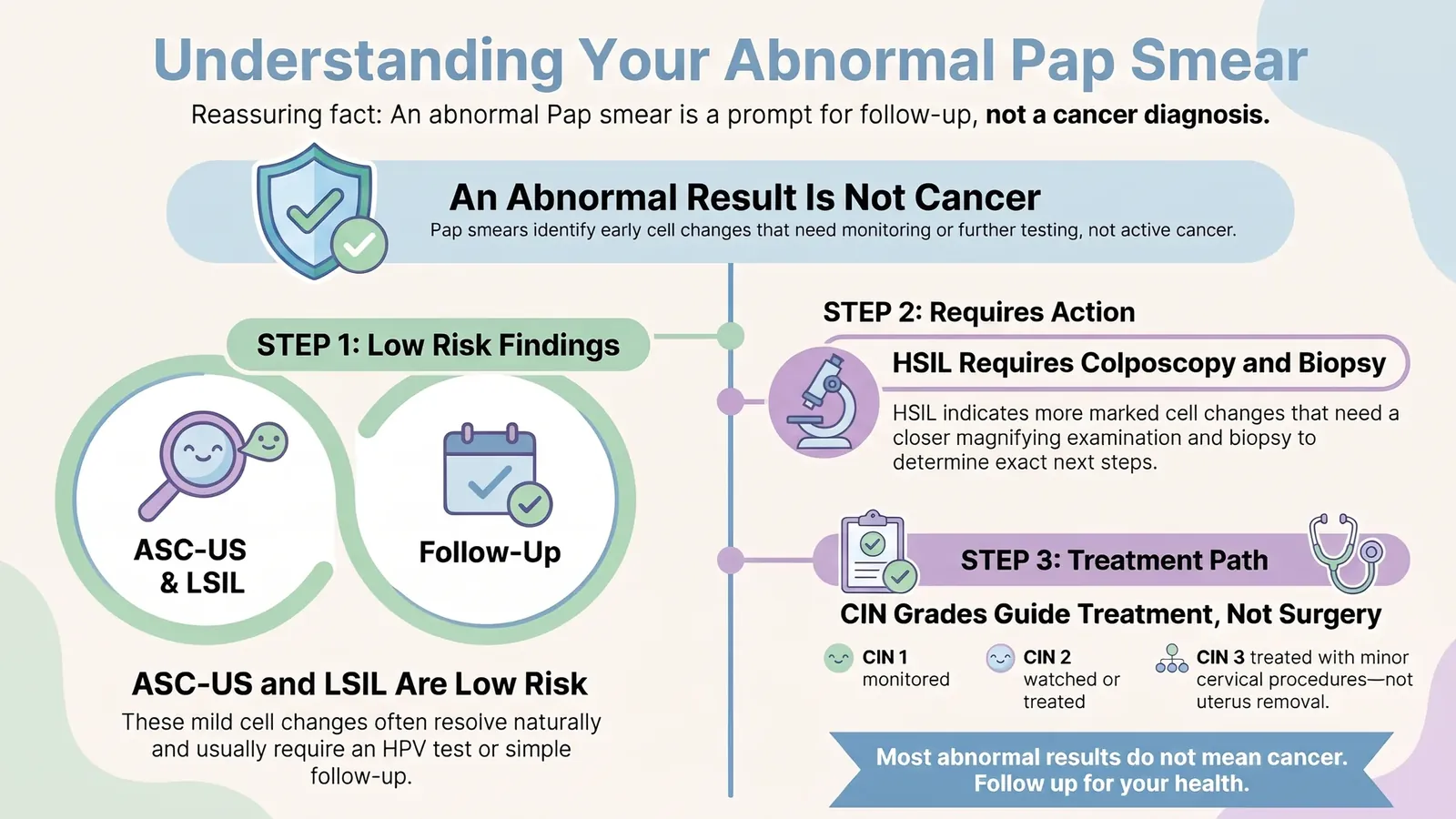
The four key points: an abnormal Pap smear is not cancer, ASC-US and LSIL are usually low risk, HSIL needs colposcopy and biopsy, and CIN grades guide treatment rather than surgery.
What a Pap smear does and does not show
A Pap smear examines cells collected from the cervix, the lower part of the uterus, and reports whether they look normal or abnormal. It does not detect HPV itself, and it cannot confirm cancer. Confirming precancer or cancer needs colposcopy and a biopsy.
A Pap smear is a brief examination. The doctor uses a speculum to see the cervix and collects cells with a small brush or spatula. The sample goes to a laboratory, where it is examined under a microscope, either as a conventional smear or as a liquid-based cytology sample. Mild discomfort or light spotting afterwards is common.
An HPV DNA test is a separate test. It detects the genetic material of high-risk HPV types, the viruses responsible for almost all cervical cancers. A positive HPV result does not mean that you have precancer or cancer, because most HPV infections clear on their own. The result is read together with your age, your Pap result and your previous reports.
A normal Pap smear does not mean you can ignore symptoms. Bleeding after sex, bleeding between periods, bleeding after menopause, persistent unusual discharge or pelvic pain need a clinical examination, whatever your last screening result showed.
The terms on your report
- ASC-US (atypical squamous cells of undetermined significance): some cells look slightly abnormal, but the pathologist cannot say for certain what is causing the change. Possible causes include HPV infection, inflammation, other infections and hormonal changes. It is one of the most common abnormal results.
- LSIL (low-grade squamous intraepithelial lesion): mild changes in the surface cells of the cervix, most often linked to HPV infection. Many of these changes go away without treatment, particularly in younger women.
- HSIL (high-grade squamous intraepithelial lesion): more marked changes and a higher likelihood of significant precancer. HSIL does not confirm cancer, but it calls for prompt colposcopy and biopsy.
Your doctor's next step depends on the result, your age, your high-risk HPV test (if one was done), your previous screening history and the guideline your doctor follows. For ASC-US and LSIL, an HPV test is often used to judge the risk. A positive high-risk result may lead to colposcopy, while a negative result may allow a longer interval before the next test. If your HPV test identifies HPV 16 or 18 specifically, it is usually followed more closely, even when the Pap smear looks mild. Our article HPV Positive: What Next? explains this in detail.
What CIN 1, CIN 2 and CIN 3 mean
CIN stands for cervical intraepithelial neoplasia. It is a biopsy term: a pathologist examines tissue under the microscope and grades how much of the thickness of the cervical lining is affected. CIN 1 is mild, CIN 2 is moderate and CIN 3 is severe. All three are precancerous. None of them is invasive cancer.
CIN 1 is a low-grade change in the lower part of the lining, usually linked to HPV infection. It often resolves as the immune system clears the virus, so most women with CIN 1 are followed up rather than treated.
LSIL on a Pap smear and CIN 1 on a biopsy often describe the same kind of change, but they are not identical. The Pap result describes cells collected from the surface, while the biopsy describes the full thickness of the lining.
CIN 2 is a moderate change involving a larger part of the lining. It is not cancer, because the abnormal cells have not invaded deeper tissue, but it cannot be ignored. A 2018 systematic review and meta-analysis in the BMJ pooled studies of women with CIN 2 who were monitored without treatment.[1] At 24 months, about half the lesions (50%) had regressed, about a third (32%) had persisted, and about 18% had progressed to CIN 3 or worse. In women under 30, regression was higher (about 60%) and progression lower (about 11%). These are averages across studies and cannot predict what will happen to an individual woman.
That is why CIN 2 is managed according to age, whether a woman wishes to have children, whether the whole transformation zone can be seen, and whether she can reliably attend follow-up. Treatment is commonly recommended. Some carefully selected women may be offered close observation, with repeat colposcopy and HPV testing.
CIN 3 is a severe change involving most or all of the thickness of the lining. It is not invasive cancer, but it is a direct precursor of cervical cancer. Some CIN 3 lesions regress, but the risk of progression is significant. For this reason, treatment is generally recommended in non-pregnant women, and observation alone is not the routine approach.
What happens next?
ASC-US and LSIL usually need repeat testing or HPV-based follow-up. HSIL needs prompt colposcopy and biopsy. A biopsy then establishes whether the change is CIN 1, CIN 2 or CIN 3, and checks for invasive disease.
- ASC-US or LSIL: HPV testing and repeat screening, or in some cases colposcopy. Colposcopy is not automatically required for everyone.
- HSIL, or a suspicious-looking area on the cervix: colposcopy and biopsy, without delay.
- Biopsy shows CIN 1: usually follow-up testing, with treatment only in selected cases.
- Biopsy shows CIN 2: treatment is commonly recommended, and carefully selected women may be observed.
- Biopsy shows CIN 3: treatment is generally recommended in non-pregnant women.
- Invasive cancer: referral to a cancer specialist for staging and treatment.
What is colposcopy?
Colposcopy is a magnified examination of the cervix using a colposcope, a light-based instrument that stays outside the body. It helps your doctor look more closely at abnormal-looking areas and decide whether a biopsy is needed. It is not an operation.
During colposcopy you lie on an examination couch, a speculum is gently placed, and the doctor examines the cervix through the colposcope. A vinegar-like solution (dilute acetic acid) is applied, and abnormal areas may turn white. Iodine may also be used. If a suspicious area is found, a small tissue sample (biopsy) can be taken. The examination is usually brief. A routine colposcopy and a small biopsy do not usually need anaesthesia. The solutions can cause mild stinging, and it is reasonable to ask for a pause at any point.
Doctors need to see the whole transformation zone, the area where the cervical lining changes from one cell type to another, because most precancerous change occurs there. Abnormal tissue can extend into the cervical canal, where it cannot always be seen. This is one reason a biopsy, or a sample from inside the canal, may be recommended even when the visible area looks small.
When should screening happen?
For the general population, WHO recommends starting HPV-based screening at age 30, with repeat testing every 5 to 10 years. Women living with HIV are advised to start at age 25 and be screened every 3 to 5 years.[2]
WHO's 2026 guideline on HPV DNA genotyping keeps HPV DNA testing as the preferred primary screening test. It also gives guidance on managing positive results according to whether a health system can reliably follow women up and treat them.[3] This matters in India, where follow-up after an abnormal result is a major challenge.
India's national programme, under the National Programme for Prevention and Control of Non-Communicable Diseases (NP-NCD), also starts at age 30 and targets women aged 30 to 65 years. Its main test is visual inspection with acetic acid (VIA), carried out at Health and Wellness Centres and Primary Health Centres, and it is generally repeated every five years.[4] This is the public-health approach. It does not mean that Pap cytology or HPV DNA testing is inappropriate. These tests are used in hospitals and clinics, depending on availability, the reason for testing and the follow-up pathway.
Do not repeat a Pap smear every few months just for reassurance. Repeat testing should follow a planned schedule set by your doctor. Screening is designed for women who feel well. It is different from investigating symptoms.
HPV vaccination protects against the HPV types that cause most cervical cancers, but it does not cover every high-risk type and cannot treat an existing infection or precancer. Vaccinated women should still follow the screening schedule that applies to them.
After an abnormal result: what to do first
- Get the complete report, including the exact cytology category and whether an HPV test was done.
- If an HPV test was done, check whether it identifies HPV 16 or 18 specifically.
- Gather previous Pap, HPV, colposcopy and biopsy reports, which help your doctor judge the risk.
- See a gynaecologist to decide whether repeat testing, colposcopy or biopsy is appropriate.
- Do not delay assessment of HSIL or of any suspicious-looking lesion on the cervix.
- If a biopsy report is overdue, contact the clinic rather than assuming the result is normal.
A second opinion is reasonable if a high-grade result is reported, if the cytology and biopsy findings do not match, or before a major treatment decision. Bring your original reports and any slides or tissue blocks the pathologist may need.
If treatment is needed, what does it involve?
Treatment for CIN is usually a small procedure on the cervix, not an operation on the uterus. Hysterectomy is not the routine treatment for CIN 3.
LEEP (loop electrosurgical excision procedure), also called LLETZ, uses a thin heated wire loop to remove the abnormal area. It is often performed as an outpatient procedure under local anaesthesia. A cone biopsy removes a cone-shaped piece of the cervix and may be used when the abnormality extends further into the cervical canal. Ablation, such as cryotherapy, destroys abnormal tissue. It is suitable only in selected cases, where the whole lesion can be seen and invasive disease has been excluded. Hysterectomy is considered only in special circumstances.
Can treatment affect a future pregnancy?
Most women treated for precancer go on to have normal pregnancies. Treatment removes some cervical tissue, and the amount removed matters. Some studies have found that preterm birth and premature rupture of the membranes are more common after excisional treatment, and that the risk can rise with the depth of tissue removed.[5][6][7] When women are compared with others who had abnormal cells but no excision, part of the apparent difference reflects the underlying disease rather than the procedure alone. Untreated CIN 3 carries a far greater risk, so treatment should not be avoided when it is needed. Ask your doctor about the planned size of the excision and what it means for future pregnancies.
Follow-up does not end with treatment
After treatment for CIN 2 or CIN 3, follow-up continues. Under the 2019 ASCCP guidelines used in the United States, women are tested with HPV tests or combined HPV and cytology at 6, 18 and 30 months. After three consecutive negative results, testing moves to every three years, for at least 25 years after treatment.[8] Follow-up in India should follow the applicable national or local guideline and your specialist's advice. The principle is the same: one normal test after treatment does not mean that follow-up can stop.
A clear margin on the pathology report is reassuring, but it does not guarantee that every abnormal cell was removed. Keep copies of your Pap, HPV, colposcopy, biopsy and treatment reports, and of every follow-up result. They help your doctor plan long-term follow-up.
"An abnormal Pap smear is a reason to take the next step, not a reason to panic."
The bottom line
ASC-US and LSIL often need only HPV-based follow-up or repeat testing. HSIL needs prompt colposcopy and biopsy. CIN 1 often resolves without treatment. CIN 2 may be treated or observed under supervision. CIN 3 is generally treated with a small procedure on the cervix. The most important thing is to complete the recommended follow-up, because screening, diagnosis, treatment and follow-up work best when they stay connected.
This article provides general health information. It does not replace a consultation or a diagnosis. Management should be based on your own cytology and biopsy reports, HPV results, age, pregnancy status and reproductive plans, together with a clinical examination.
Frequently Asked Questions
References
- Tainio K, Athanasiou A, Tikkinen KAO, et al. Clinical course of untreated cervical intraepithelial neoplasia grade 2 under active surveillance: systematic review and meta-analysis. BMJ. 2018;360:k499. doi:10.1136/bmj.k499.
- World Health Organization. WHO guideline for screening and treatment of cervical pre-cancer lesions for cervical cancer prevention, second edition. Geneva: WHO; 2021.
- World Health Organization. WHO guideline for screening and treatment of cervical pre-cancer lesions for cervical cancer prevention: use of human papillomavirus (HPV) DNA genotyping. Geneva: WHO; 2026. ISBN 978-92-4-012174-4.
- Government of India, Ministry of Health and Family Welfare. Operational Framework: Management of Common Cancers. 2016.
- Sadler L, Saftlas A, Wang W, et al. Treatment for cervical intraepithelial neoplasia and risk of preterm delivery. JAMA. 2004;291(17):2100–2106. doi:10.1001/jama.291.17.2100.
- Conner SN, Frey HA, Cahill AG, et al. Loop electrosurgical excision procedure and risk of preterm birth: a systematic review and meta-analysis. Obstet Gynecol. 2014;123(4):752–761. doi:10.1097/AOG.0000000000000174.
- Kyrgiou M, Koliopoulos G, Martin-Hirsch P, et al. Obstetric outcomes after conservative treatment for intraepithelial or early invasive cervical lesions: systematic review and meta-analysis. Lancet. 2006;367:489–498. doi:10.1016/S0140-6736(06)68181-6.
- Perkins RB, Guido RS, Castle PE, et al. 2019 ASCCP risk-based management consensus guidelines for abnormal cervical cancer screening tests and cancer precursors. J Low Genit Tract Dis. 2020;24(2):102–131.
Related Reading

Got an abnormal Pap smear report and not sure what comes next?
Dr. Dipanwita Banerjee offers consultations at CNCI Kolkata for gynaecological cancers, including review of Pap, HPV, colposcopy and biopsy reports.