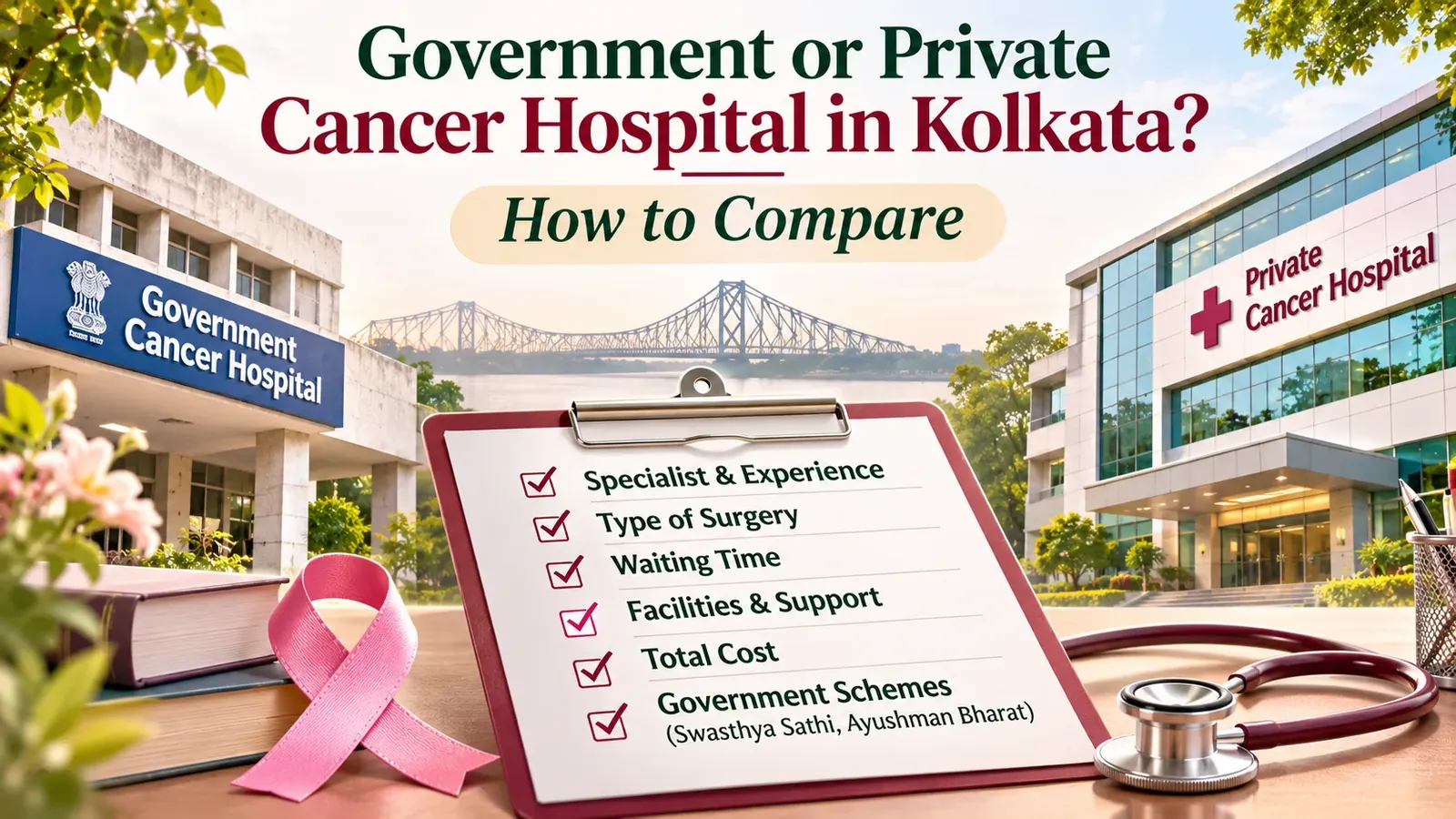
The right hospital is the one whose team can deliver the right treatment safely, in good time, and within what the family can manage.
When a woman is diagnosed with ovarian, uterine or cervical cancer, one of the first decisions is where to be treated. Should we go to a government cancer institute? Will a private hospital be better? Is the more expensive operation the safer one? Should we choose a well-known hospital, or a particular surgeon?
These are reasonable questions. Cancer treatment can involve major surgery, chemotherapy, radiotherapy, repeated tests and months of follow-up. The choice affects her health, the family's money, the time people can give and everyone's emotional strength. There is no single right answer, but there are fair ways to compare, and this article explains them.
Is government cancer treatment as good as private?
It can be. Neither type guarantees good treatment. A hospital's name, building or price says little about whether the proposed treatment is right for the patient.
Government cancer institutes often have experienced specialists, dedicated departments, large patient numbers and teaching programmes, and they treat complex cases every day. Private and charitable hospitals can also provide excellent care, with modern operating theatres, advanced imaging and coordinated teams.
What matters is whether the team can:
- Assess the full extent of the disease and review the scans and pathology carefully.
- Judge whether surgery is likely to remove the cancer safely, or whether chemotherapy should come first.
- Provide anaesthesia, blood transfusion and intensive care when needed.
- Coordinate medical oncology, radiotherapy and follow-up.
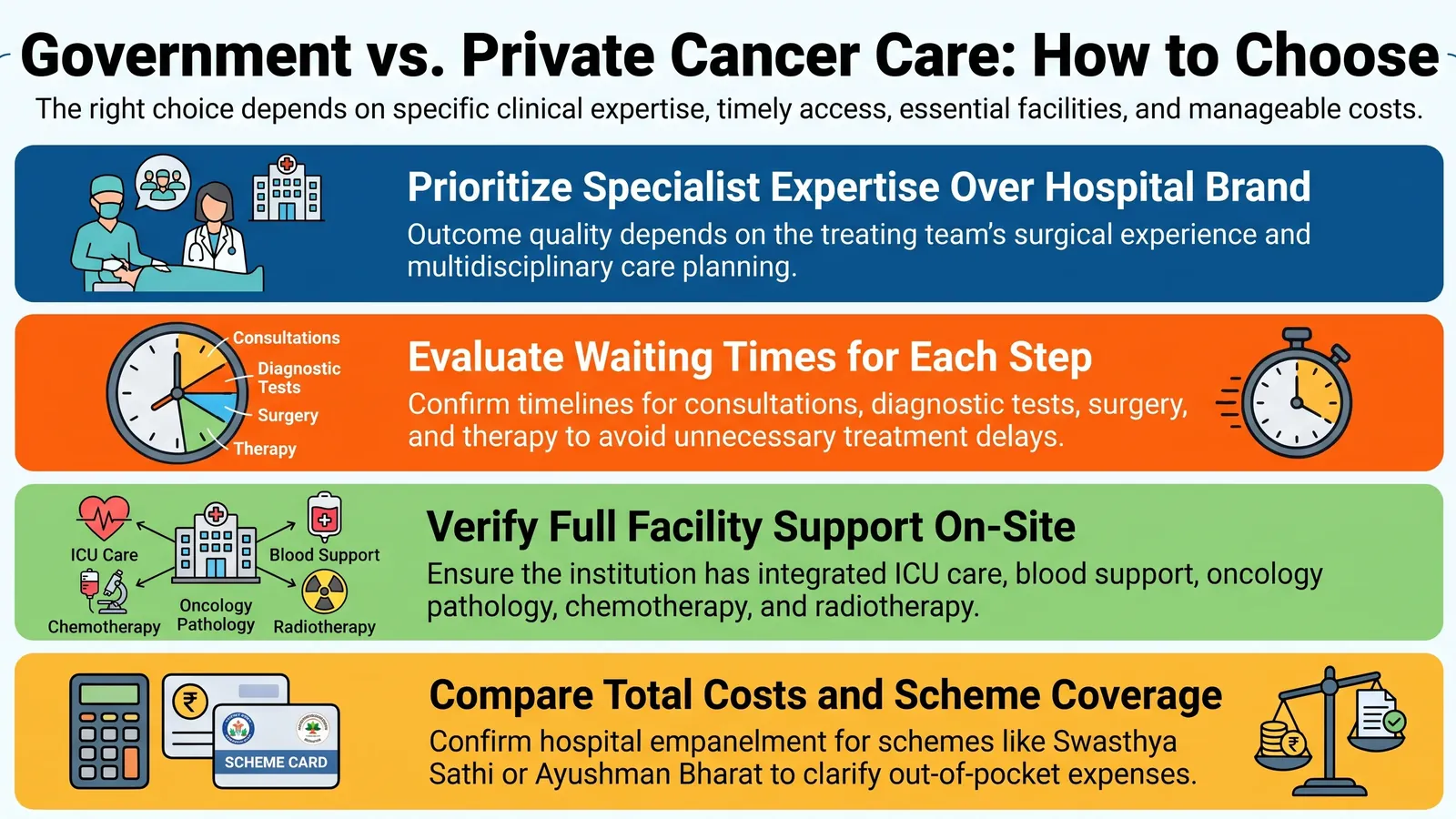
Four things to check, whichever type of hospital you are considering.
Does a hospital's reputation tell us what is best?
No. Reputation is a starting point, not a verdict. Hospitals in Kolkata differ in whether they are government, charitable or private, and each describes its services in its own material. Treat those descriptions as claims to check, not as proof of quality.
For advanced ovarian cancer surgery, the European Society of Gynaecological Oncology (ESGO) has published ten quality indicators covering complete tumour removal, surgical caseload and training, multidisciplinary decision-making, pre-operative assessment, perioperative care and recording of complications.[1] If a hospital says it holds ESGO accreditation, ask for the certificate. Accreditation requires at least 24 complete cytoreductive surgeries for advanced epithelial ovarian cancer a year, including at least 12 primary operations.[2]
Ask for the following, whatever the hospital:
- The surgeon. Who would operate, and how many advanced ovarian cancer operations does that surgeon perform each year?
- The team. Is her case reviewed by a multidisciplinary team before treatment is decided?
- The plan. Would the team recommend surgery first or chemotherapy first, and why?
- The fallback. If complete removal of visible disease is not safe, what is the plan?
- The cost. What is the total estimated cost, including chemotherapy and follow-up?
Does the surgeon matter more than the hospital?
Both matter, and neither works alone. A skilled surgeon is essential for complex ovarian cancer surgery, but even an experienced surgeon needs a hospital that can provide anaesthesia, blood, intensive care, pathology and post-operative support.
Higher surgical volume has been linked to better results. A large US database study found that survival was lower at hospitals doing fewer than about 21 advanced ovarian cancer operations a year.[3] A 2025 systematic review found that higher hospital volume was associated with better survival and surgical quality, but the studies differ widely in design and in how volume is defined.[4] Volume does not determine an individual's result, but it supports treatment in an experienced, well-organised team.
ESGO's indicators are quality standards, not guarantees for an individual patient. As of ESGO's 2023 study design, no large international multicentre study had yet validated them.[5] That is one reason to ask questions rather than rely on any single label.
"Who will operate on the patient, and how often does that surgeon perform advanced ovarian cancer surgery?"
Should the patient choose government or private treatment?
There is no universal answer. The right choice depends on the type and stage of her cancer, the specialist and services she needs, her general health, how soon she can be seen, the family's finances and any scheme or insurance she has, and travel and accommodation. These are general patterns, and individual hospitals differ:
- Cost: government institutes are often lower, but depend on the patient's category and the service. Private-pay care is often higher, and some charitable hospitals subsidise care.
- Specialist expertise: can be very high in some centres of both types.
- Waiting times: can be longer for some government appointments or procedures. Private hospitals may be sooner for some services, but this is not guaranteed.
- Schemes and insurance: depend on empanelment for the specific treatment, in either sector.
- Family accommodation: varies. Some charitable hospitals provide it.
Is treatment slower in government hospitals?
It can be, for some services, but waiting times vary a great deal between departments, procedures and clinical urgency. Large government institutions often treat patients from many districts, which can put pressure on appointments, scans, beds and operating theatres. Private hospitals may offer earlier appointments, but a complex operation still needs investigations, anaesthesia assessment, correction of anaemia or other problems, and a suitable operating slot.
Ask for a timeline at each step:
- When can the patient see the relevant specialist?
- When will the necessary tests be complete, and when will the plan be final?
- If surgery is advised, what is the likely date? If chemotherapy comes first, when does the first cycle start?
- If radiotherapy is needed, when does planning begin?
A short wait for proper tests and preparation is different from an unexplained delay. If the wait becomes long, a second opinion can be sought while the current pathway stays active. Do not stop treatment planning while comparing hospitals.
Is private treatment worth the extra cost?
Sometimes. A private hospital may offer earlier access to a specialist, easier appointments or a particular service, which matters when the family is travelling or treatment needs repeating. But a higher bill does not automatically mean better cancer treatment. If two hospitals can offer the same evidence-based treatment, with comparable expertise, safety and timely access, paying more may not improve the outcome.
Ask for an itemised estimate that covers:
- Consultation, admission, scans, blood tests and pathology.
- Molecular or genetic tests, if needed.
- Surgeon and anaesthesia fees, operating theatre and consumables.
- Medicines, blood products, and intensive care if needed.
- Chemotherapy, radiotherapy if required, and follow-up visits and tests.
Ask what is included and what may be charged separately. A low first estimate may not reflect the total cost of treatment.
Does expensive surgery mean better cancer treatment?
No. The price of an operation reflects room category, hospital charges, equipment and consumables, and none of these automatically improves cancer control. In advanced ovarian cancer, the main aim of surgery is to remove all visible disease when this can be done safely. A good outcome depends on whether surgery was the right choice for the disease and her health, whether a trained gynaecological cancer surgeon performed it, whether complete removal was achieved where feasible, whether complications were prevented or treated promptly, and whether chemotherapy and other treatment were planned together.
What facilities should a cancer hospital have?
Not every patient needs every facility, but a hospital treating gynaecological cancers should be able to cover the whole pathway, or coordinate a safe handover if she must move:
- Specialists: gynaecological oncology, medical oncology, radiation oncology, and anaesthesia and critical care.
- Diagnosis: ultrasound, CT and MRI, PET-CT when indicated, histopathology, immunohistochemistry, and BRCA and HRD testing when indicated.
- Team decisions: a structured multidisciplinary team that reviews complex cases together.
- Surgery support: operating theatres, experienced anaesthesia, a blood bank, and ICU and high-dependency care.
- Chemotherapy and radiotherapy: trained oncology nurses, side-effect monitoring, a clear route for urgent assessment of fever, and external beam radiotherapy and brachytherapy where needed.
- Supportive care: pain control, nutrition, counselling, and palliative care alongside active treatment, not only at the end of life.
Questions for ovarian cancer surgery
Ask every hospital the same questions:
- Is the diagnosis confirmed, and has the pathology been reviewed?
- What is the likely stage and extent of disease?
- Should surgery come before or after chemotherapy, and why?
- What is the expected aim of surgery, and is complete removal of visible disease feasible?
- Which organs might need to be operated on, and what are the main risks and likely recovery period?
- What is the plan if complete removal is not safe, and what treatment is expected after surgery?
Schemes in West Bengal: Swasthya Sathi and Ayushman Bharat
Swasthya Sathi is West Bengal's state health scheme. It provides cashless secondary and tertiary hospital treatment of up to ₹5 lakh per family per year at empanelled hospitals.[6]
Ayushman Bharat PM-JAY is the national scheme, which provides up to ₹5 lakh per family per year for specified secondary and tertiary hospital care at empanelled hospitals. West Bengal signed a memorandum of understanding with the National Health Authority on 8 June 2026 to implement it.[7] Swasthya Sathi and PM-JAY are separate schemes, and eligibility under one does not automatically establish eligibility under the other.
Because the position is changing, confirm the following with the hospital's scheme desk before admission:
- Is the patient eligible under the relevant scheme, and is the hospital currently empanelled?
- Is the proposed cancer treatment covered under an approved package?
- Is pre-authorisation required, who submits it, and when?
- What happens if the annual limit runs out during expensive treatment?
- Which expenses, medicines or investigations may not be covered?
Newer state rules for families outside PM-JAY have also been reported in 2026. Ask which scheme applies to the family rather than assuming. Coverage is package-based, not every drug, test or consumable is included, and for private health insurance, check waiting periods, exclusions, sub-limits and whether the hospital is in the insurer's cashless network. Ask for written confirmation of the expected out-of-pocket amount wherever possible.
What does NABH accreditation mean?
NABH, the National Accreditation Board for Hospitals and Healthcare Providers, is a constituent board of the Quality Council of India. It assesses hospitals against national standards covering patient rights, medication management, infection control, patient safety and quality improvement. It assesses the institution, not the individual competence of every doctor, and it does not guarantee the outcome of a particular cancer operation. A hospital without NABH accreditation is not automatically unsafe, and an accredited hospital is not automatically the right choice. Ask which certificate and which service it refers to.
Moving between hospitals
Yes, in many situations. Continuity is what matters. Before changing hospitals, gather consultation notes, histopathology reports, original biopsy slides or tissue blocks if available, scan reports and images, operation notes and discharge summaries, a record of chemotherapy with drug names, doses, dates and side effects, radiotherapy records, and recent blood tests. The new team should review these and confirm the next steps without repeating tests unnecessarily.
Frequently asked questions
Frequently Asked Questions
Is government cancer treatment automatically cheaper?
Often, but not always. Charges depend on the hospital, the patient's category, the service and any scheme. Ask for the current charge schedule and the category that applies.
Are private hospitals always faster?
No. Some offer earlier appointments, but waiting times depend on the specialist, the treatment needed, operating theatre availability and clinical urgency.
Is a larger hospital always better?
Not necessarily. What matters is whether it has the specialist team and services needed for the particular cancer.
Can we choose a hospital from online reviews?
Reviews can tell you about communication and the experience of visiting. They cannot reliably show the quality of cancer surgery, so use them only as one small input.
What if we cannot afford the treatment she needs?
Start by identifying the treatment she medically needs. Then ask the hospital's medical social worker or patient welfare department what support is available, and check whether the full pathway can be completed at one institution. A cheap operation followed by unaffordable chemotherapy is not a saving.
Choose the team that can provide the right treatment safely, within a reasonable time, and in a way your family can manage financially and practically. The right hospital is not the one with the most expensive label.
This article helps patients and families understand how to compare cancer hospitals. It does not rank hospitals and does not replace a consultation with a doctor. The right hospital and treatment depend on the cancer type, stage, pathology, general health and previous treatment. Hospital services, scheme empanelment, charges and waiting times change, so confirm them directly with the institution before making a decision. In an emergency, seek medical care immediately.
References
- European Society of Gynaecological Oncology. Quality indicators for advanced ovarian cancer surgery. Int J Gynecol Cancer. 2016. doi:10.1097/IGC.0000000000000767.
- European Society of Gynaecological Oncology. ESGO accreditation in advanced ovarian cancer surgery: requirements and application. ESGO website.
- Bristow RE, Palis BE, Chi DS, Cliby WA. The National Cancer Database report on advanced-stage epithelial ovarian cancer: impact of hospital surgical case volume on overall survival and surgical treatment paradigm. Gynecol Oncol. 2010;118(3):262–267.
- Luo Q, Wang Y, Zhang X. Association between hospital volume and outcomes in ovarian cancer: a systematic review. Front Surg. 2025. doi:10.3389/fsurg.2025.1635555.
- European Society of Gynaecological Oncology. Study synopsis: prognostic impact of the ESGO quality indicators for advanced ovarian cancer surgery. 2023.
- Government of West Bengal, Department of Health and Family Welfare. Swasthya Sathi scheme: main features. State government portal.
- Government of India, Ministry of Health and Family Welfare. Announcement on West Bengal's joining AB PM-JAY through a memorandum of understanding with the National Health Authority. June 2026.
Related Reading

Choosing where to be treated?
Dr. Dipanwita Banerjee offers consultations at CNCI Kolkata to review the diagnosis and plan the treatment pathway for gynaecological cancers.