
Costs, treatment options and financial help, explained step by step.
A cancer diagnosis brings medical decisions and financial ones at the same time. Surgery, chemotherapy, radiotherapy, tests and follow-up can add up quickly, and many families in Kolkata worry about how they will manage. This article explains what drives the cost of gynaecological cancer treatment, how to ask for a useful written estimate, and which schemes and forms of help may apply.
If Cost Is a Worry, What to Do First
Tell the treating team early, ask for a written, itemised estimate for the whole planned treatment, and confirm in writing which health scheme applies. Do not stop or change treatment on your own because of cost.
- Talk to the team early. Do not wait until the bill arrives.
- Ask for a written, itemised estimate for the full plan, not just the first procedure (see below).
- Check your scheme at the hospital's scheme desk, in writing. Keep your Swasthya Sathi card and any Ayushman Bharat details.
- Ask the social-work or patient-welfare office about hospital concessions, the central cancer fund and charitable support.
- Start applications early, and keep copies of everything.
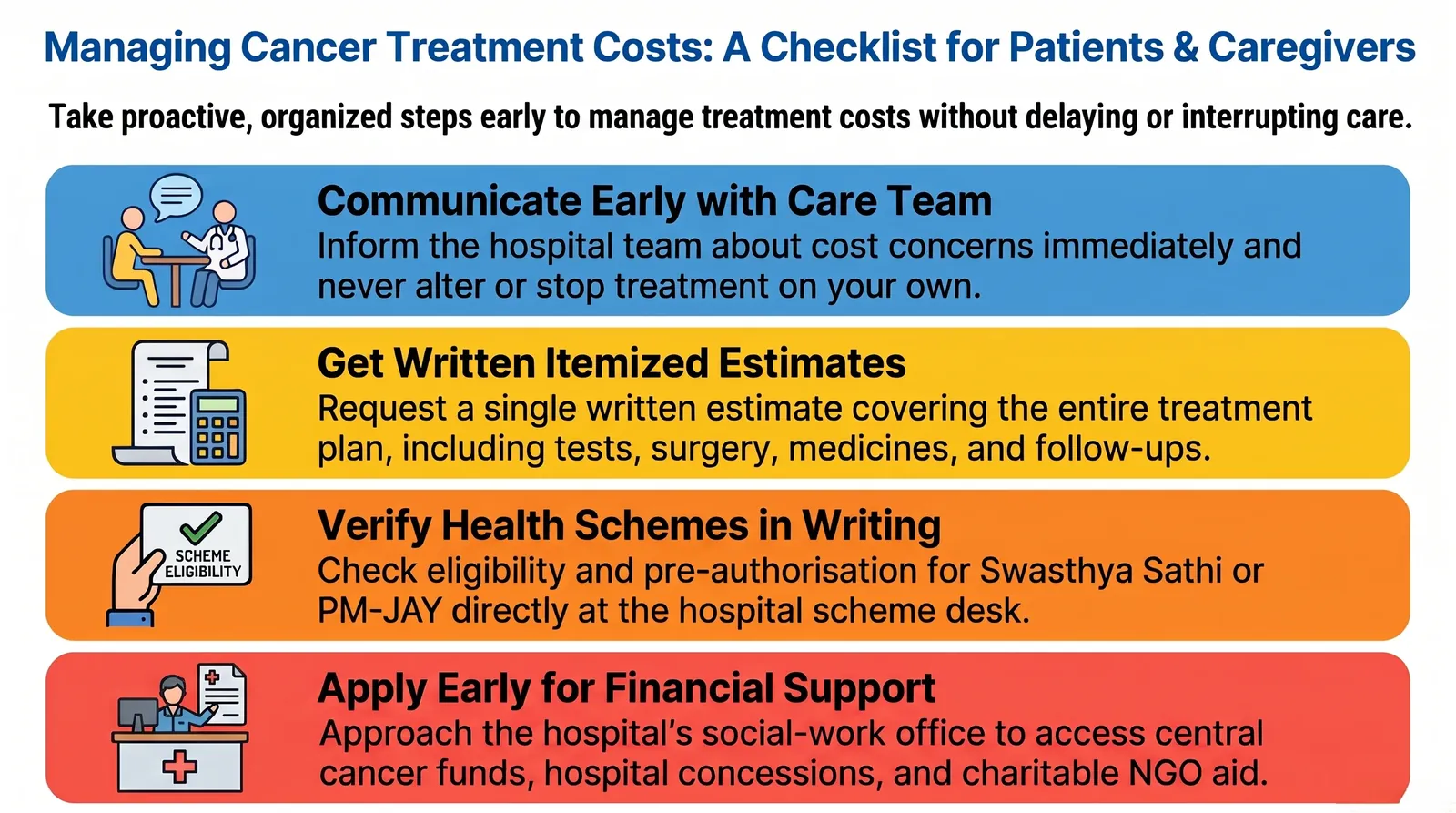
Plan early, ask in writing, and never stop treatment because of cost alone.
Why This Article Does Not Give One Price
Treatment costs depend on the type and stage of cancer, the operation or treatment plan, the medicines, the hospital and ward category, and whether any scheme or assistance applies. Two patients with the same diagnosis can face very different bills.
We have not published private-hospital prices for these procedures and tests, because a single figure would be misleading for most families. Instead, this article explains what each cost includes, what to ask for, and where help is available.
How to Get a Useful Written Estimate
Ask the hospital's billing team for an estimate that states:
- The procedure or treatment plan, and the number of chemotherapy cycles or radiotherapy sessions.
- Whether consultation, anaesthesia, operation-theatre charges, pathology, medicines, implants, consumables, hospital stay and follow-up are included.
- The ward or patient category the quote assumes. Charges differ by category.
- Which items are excluded and may be billed separately.
- The total estimate, and the amount the hospital expects a scheme or assistance to cover.
A low advertised price for one procedure may leave out several of these items. Compare estimates that list the same items.
A Simple Budgeting Worksheet
Build the family's estimate from these headings, using the written quotes:
- Diagnostic tests and pathology, including any biopsy or imaging.
- Surgery and admission, including anaesthesia and the expected stay.
- Each planned chemotherapy cycle or radiotherapy session, with medicines and monitoring tests.
- Medicines and supportive treatment prescribed after discharge.
- Follow-up visits and tests.
- Travel, accommodation and food, particularly if you are coming to Kolkata from outside the city.
- Lost income for the patient and the family member who accompanies them.
Ask the hospital what would happen to the estimate if the treatment plan changed. Do not add a percentage for unexpected costs unless the hospital or your financial adviser gives you a basis for it.
What Drives the Cost of Each Treatment?
Ovarian, uterine and cervical cancer
Ovarian cancer treatment usually combines surgery and chemotherapy. The total depends on how extensive the surgery is, how many cycles are needed, which drugs are used and how long the admission lasts. Uterine cancer often begins with surgery; higher-risk disease may also need radiotherapy or chemotherapy. Early cervical cancer may be treated by surgery, while locally advanced disease is often treated with radiotherapy and chemotherapy together, followed by brachytherapy. In each case, ask the treating team which treatments the pathology report recommends, then ask for an estimate for each.
Surgery and hysterectomy
A cancer hysterectomy can be more extensive than a routine one. It may include removal of the ovaries and fallopian tubes, lymph-node assessment and pathology. A routine hysterectomy estimate is not a reliable guide. Ask the hospital to state the exact procedure, whether the ovaries and tubes are removed, and whether lymph nodes and frozen-section pathology are included.
Robotic surgery may be offered for selected uterine and cervical cancers. It is not necessary for every patient, and the approach should be chosen on clinical grounds. Its cost depends on the system, disposable instruments, operating time and stay, so ask for the robotic charge separately from the surgeon's fees, anaesthesia, stay and pathology.
Chemotherapy, radiotherapy and brachytherapy
Chemotherapy cost depends on the drugs, doses, supportive medicines, the day-care or indoor setting, and monitoring tests. Ask whether a per-cycle quote includes the drugs, administration, nursing, blood tests, anti-nausea medicines, any growth-factor injection prescribed, and any venous access device. Drug and regimen decisions are medical decisions. Do not change them for cost reasons without discussing alternatives with the oncologist, but do ask whether a suitable lower-cost generic option exists.
Radiotherapy cost depends on the technique, number of sessions, planning, imaging and review visits. Brachytherapy places a radiation source inside or close to the tumour, and its cost depends on the number of applications, anaesthesia and imaging. For both, ask for a total for the whole course, and confirm whether a quote covers the whole course or only one application.
Tests and scans
PET-CT and MRI are used for selected clinical questions. Their cost depends on the scan and any contrast or extra sequences, so ask for a quote for the specific scan your doctor has requested and ask whether the result will change management. For biopsy, hysteroscopy and colposcopy, ask whether the quote includes the procedure, anaesthesia, any biopsy and the histopathology report. BRCA testing cost depends on whether the test covers specific variants, full genes or a wider panel, and whether counselling and interpretation are included. Your doctor or genetic counsellor should advise which test is clinically indicated.
Does a more advanced stage cost more?
Often, because advanced disease usually needs more extensive surgery, more chemotherapy and longer follow-up. However, stage alone does not decide the bill. The treatment plan, drugs, complications and hospital all matter.
Summing unrelated online prices is misleading, because they often leave out medicines, pathology, admission, supportive care and follow-up. Build your total from written quotes for the full plan.
West Bengal's Health-Cover Arrangements in 2026
The arrangements changed in 2026 and are still being rolled out. Confirm the position with the hospital's scheme desk before admission, because published reports give different start dates.
Reports say West Bengal signed its agreement with the National Health Authority on 8 June 2026 to implement Ayushman Bharat PM-JAY, becoming the 36th state or union territory to do so. The scheme is described as providing up to ₹5 lakh per family per year for secondary and tertiary hospital care.[1] Start dates in later reports differ, and one news report gave 16 August 2026 for the roll-out in the state.[2] We have not been able to confirm the detailed rules from an official notification.
Swasthya Sathi, the state's existing scheme, has provided cashless inpatient cover of up to ₹5 lakh per family per year at empanelled hospitals. Reports describe a transition in which Swasthya Sathi and the new arrangements may run alongside each other before a phased change.
What this means for you:
- Eligibility under PM-JAY depends on your family's status on the government's beneficiary list, not only on where you live. Check it on the official portal or through a participating hospital.
- Hospital empanelment and the specific treatment package must both be confirmed.
- Do not assume the two schemes can be combined, transferred or used interchangeably for the same admission. Ask the scheme desk which one applies, and get the answer in writing.
- Keep your Swasthya Sathi card and any Ayushman Bharat number.
Do These Schemes Cover Cancer Treatment?
PM-JAY's health benefit packages include oncology packages covering surgery, medical oncology and radiation oncology. Coverage applies only to the procedures in the relevant package and only at hospitals empanelled for it.[3] Check the package for each planned treatment in writing, and do not assume a routine hysterectomy package covers a more complex cancer operation.
Swasthya Sathi has provided cashless inpatient cover for cancer care at empanelled hospitals. Whether a particular operation, chemotherapy course or radiotherapy course is covered depends on the approved package and the hospital's empanelment. Before admission, ask in writing: Is this specific procedure covered? Is pre-authorisation needed? What, if anything, will the family have to pay?
Empanelment does not automatically mean every service is covered. Both schemes operate only at hospitals empanelled for them.
Government and Charitable Financial Help
Government hospitals
Government institutions often charge much less than private hospitals, and some services are free or subsidised for eligible patients. However, a government hospital does not automatically mean free treatment for everyone. Medicines, investigations, waiting times and patient category all affect the bill. At registration, ask which category applies, what the charges are, and whether charges can be waived or reduced.
Chittaranjan National Cancer Institute (CNCI) publishes a schedule of charges, which uses patient categories that the schedule itself does not explain. Confirm what the categories mean with the institute before relying on them.[4] The institute's right-to-information disclosure states that for poor patients, charges for various tests can be fully waived by the Medical Superintendent.[5] Ask the institute what applies to your case.
Private hospitals
Some private cancer hospitals have financial-assistance policies for patients who are not covered by insurance or another scheme, often decided by a physician and a medical social worker after a written application. Such assistance depends on the hospital's current policy and its own assessment, and is not a guarantee. Ask the hospital for its written policy before relying on it.
Cancer-treatment subsidies
Each of these has conditions:
- The Health Minister's Cancer Patient Fund, a component of Rashtriya Arogya Nidhi, provides one-time assistance of up to ₹15 lakh for eligible patients below the state poverty line who are treated at government cancer facilities. ₹15 lakh is a maximum, not a standard grant. Ask the treating government hospital's welfare or social-work office about current requirements.[6]
- The Indian Cancer Society's Cancer Cure Fund gives financial aid for treatment to underprivileged patients at empanelled hospitals. The official page states that family income must not exceed ₹4 lakh per year. The organisation's own presentations also describe a maximum support per patient and expected survival as considerations, so confirm current eligibility, fund availability and empanelled hospitals directly.[7] Its diagnostic-test support for PET-CT, MRI and biopsy has also been reported.[8]
- The Prime Minister's National Relief Fund may assist with medical treatment, but assistance is discretionary and approved by the Prime Minister's Office. Do not plan treatment around it.
- Hospital concessions. Ask whether the hospital has a concession category, waiver or patient-welfare fund.
Some charitable organisations also help patients with treatment costs, medicines or investigations, subject to their own assessment. Confirm current services, eligibility and required documents, and ask your hospital's social worker which organisations they work with.
How to Prepare for Financial Help
- Get the written treatment plan, including the regimen, planned cycles and tests.
- Request an itemised estimate for each cycle and for the whole course.
- Check coverage with the scheme desk, including pre-authorisation and exclusions.
- Ask about lower-cost medicines, and do not change the regimen without medical advice.
- Approach the social-work office about hospital funds, the central cancer fund and charities.
- Prepare documents early: diagnosis and pathology reports, the treatment plan and estimate, identity and address proof, scheme cards, income or financial-status certificates where required, and prescriptions.
- Apply early, and keep copies of every application, estimate, bill and letter.
What If We Cannot Afford Treatment?
Tell the treating team before treatment is interrupted. Ask whether a government cancer centre can provide the treatment, which scheme applies and whether coverage is confirmed in writing, whether a hospital concession or a charitable route applies, and whether the social-work office can help with applications.
Do not stop, delay or change treatment on your own because of cost. Ask whether a clinically appropriate alternative or a lower-cost centre is available. If travel, accommodation or lost income is a problem, mention that too.
The Key Message
Gynaecological cancer treatment costs vary widely, and no single figure applies to every family. The most reliable steps are a written, itemised estimate for the whole plan, written confirmation of which scheme applies, and early contact with the hospital's social-work office about concessions and assistance.
Frequently Asked Questions
Disclaimer: This article provides general information. It is not a price list, and it is not financial or legal advice. Confirm current charges, eligibility and coverage directly with the hospital or official programme. Treatment decisions should be made with the treating medical team.
References
- ThePrint. West Bengal officially becomes the 36th state or union territory to implement Ayushman Bharat PM-JAY. 10 June 2026. theprint.in
- Outlook Money. Ayushman Bharat scheme to roll out in West Bengal from August 16. News report, 2026. Start dates differ across reports; not an official notification. outlookmoney.com
- National Health Authority, Government of India. National Health Benefit Package 2.2: User Guidelines. NHA. nha.gov.in
- Chittaranjan National Cancer Institute. Schedule of Charges, effective 1 September 2024. CNCI, Kolkata. cnci.ac.in
- Chittaranjan National Cancer Institute. Right to Information disclosure on patient services and charges. CNCI, Kolkata, 2024. cnci.ac.in
- Ministry of Health and Family Welfare, Government of India. Lok Sabha Unstarred Question No. 5561, answered 4 April 2025: Health Minister's Cancer Patient Fund under Rashtriya Arogya Nidhi. Lok Sabha. eparlib.sansad.in
- Indian Cancer Society. Cancer Cure Fund: patient eligibility. Indian Cancer Society, Mumbai. indiancancersociety.org
- Soulace Consulting. HDFC AMC–Indian Cancer Society Cancer Cure Fund: impact assessment, FY 2022–23. Impact assessment report. indiancancersociety.org
Related Reading

Planning treatment and worried about cost?
Dr. Dipanwita Banerjee offers consultations at CNCI Kolkata. Bring your reports and ask the scheme and billing questions in this guide.