
Menopause and sexual health are part of recovery. They deserve the same attention as scans and blood tests.
Pelvic cancer treatment can bring menopause early and can change how the body feels during intimacy. Many women are not given clear information about this before treatment starts, and some learn about it only when symptoms begin. This article explains what happens, why it happens and what can help. Your cancer type, its stage and your treatment decide which points apply to you, so use it to prepare questions for your team, not as a replacement for their advice.
Does gynaecological cancer treatment cause menopause?
Removing both ovaries before natural menopause causes sudden, surgical menopause. Removing only the uterus does not cause menopause if the ovaries keep working. Chemotherapy and pelvic radiotherapy can also damage the ovaries, sometimes only for a time.
A hysterectomy alone stops your periods, because the uterus is removed, but it does not stop the ovaries making hormones. Periods can no longer tell you when natural menopause is coming, and pregnancy is no longer possible. Natural menopause usually still happens at around the expected age.[1]
- Both ovaries removed: if you have not yet reached natural menopause, menopause can begin within hours or days of surgery. This is called surgical menopause.[2]
- One ovary removed: usually no menopause, because the other ovary can keep working.
- Chemotherapy or pelvic radiotherapy: can damage the ovaries and cause early menopause, which is sometimes temporary. Periods returning does not always mean the ovaries have fully recovered, so ask your team how to check.
Why do hormones matter so much?
The ovaries make oestrogen and progesterone. Oestrogen keeps the vaginal lining moist, elastic and healthy. It also helps protect bone strength and plays a part in sleep, body temperature and sexual comfort. When oestrogen drops suddenly, all of these can change at once. The infographic below shows how treatment affects the body and what the main options are.
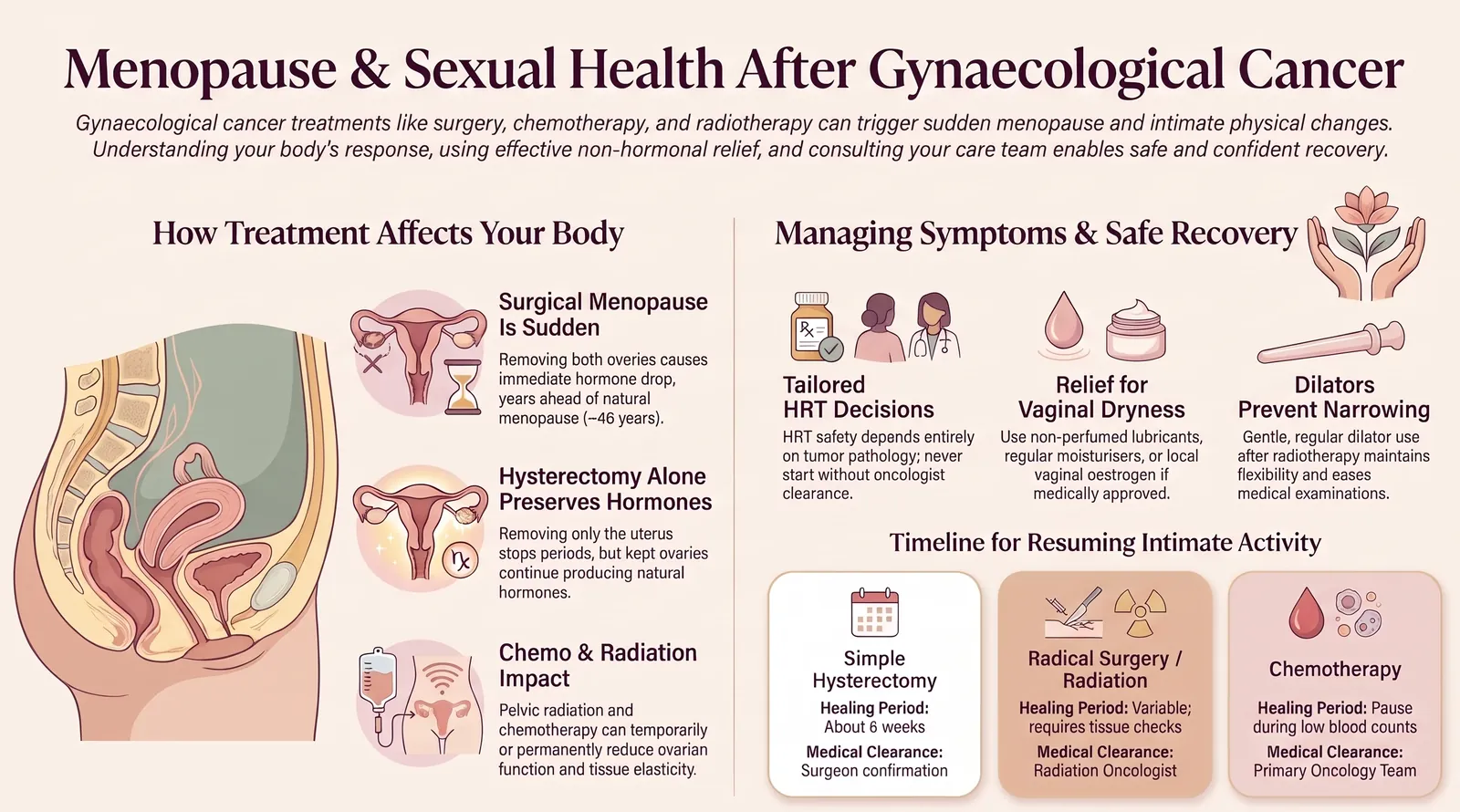
Treatment affects the body in different ways. Your options depend on your own cancer and treatment.
What symptoms should I expect after surgical menopause?
Surgical menopause can bring hot flushes and night sweats, poor sleep, mood changes, vaginal dryness and pain during sex, lower desire, urinary urgency, trouble concentrating and joint aches. Younger women often find this harder, because it comes much earlier than expected. In India, natural menopause usually happens around age 46 on average, according to Indian Menopause Society guidelines.[1] This is an average, so individual ages vary.
Losing ovarian hormones early also affects bone strength and, over the longer term, heart and metabolic health. Bone loss can start soon after surgical menopause, so we explain how to protect your bones in the section below. If you may want children in future, ask about fertility options before treatment begins. Our guide Can I Have Children After Gynaecological Cancer? explains them.
How can I protect my bones after surgical menopause?
If both ovaries are removed before natural menopause, bone strength can start to fall soon after surgery. Calcium and vitamin D from food, regular exercise, a bone density test when your team advises it, and a discussion about hormone replacement therapy can all help protect your bones.
When both ovaries are removed, oestrogen falls suddenly. Oestrogen keeps a healthy balance between bone building and bone breakdown. Without it, bone breakdown speeds up, bones gradually become thinner, and the risk of osteoporosis (weak, fragile bones) and fractures rises.[1]
Younger women carry this risk for many years. Other treatments can add to it. Pelvic radiotherapy can weaken the bone within the radiation field and raise the risk of fractures from everyday pressure.[2] Chemotherapy can bring on early menopause, and some hormone-blocking medicines also lower oestrogen.[2]
Bone loss usually causes no pain at first. Many women first learn that their bones are weak after a fracture, which is why bone health should be looked at early rather than after a problem appears.[1]
Who is at higher risk?
- Both ovaries were removed before natural menopause.
- Chemotherapy or pelvic radiotherapy has brought on early menopause.
- You are taking an aromatase inhibitor or another medicine that lowers oestrogen.
- You have a low body weight, eat little calcium, have low vitamin D, or are not very active.
Smoking and regular alcohol use also lower bone density.[2]
Calcium: start with food
Calcium builds and maintains strong bones. The Indian Menopause Society's 2026 guideline advises a total calcium intake of 1000 to 1200 mg a day from food and supplements together, with supplements used to fill any gap.[1] Your doctor will check what you already eat before suggesting a supplement.
Calcium-rich foods commonly eaten in India include milk, curd and paneer; ragi (finger millet); sesame seeds (til); green leafy vegetables; pulses and beans; and small fish eaten with their bones. Including several of these every day helps.
More calcium does not automatically mean stronger bones. Do not start high-dose calcium tablets without checking how much you already eat.
Vitamin D: helps your body use calcium
Vitamin D helps the body absorb calcium. Low vitamin D is common in India, including in women who spend time in the sun.
A blood test for 25-hydroxy vitamin D shows your level. For women at higher risk of bone loss, the joint UK guideline suggests either checking the level or taking 1000 IU of vitamin D a day.[2] Your doctor will choose what suits you. Do not take high-dose vitamin D sachets or injections without medical advice.
Exercise: keep your bones and muscles working
Weight-bearing exercise, such as walking, climbing stairs and dancing, is encouraged for bone health.[2] Research on whether exercise alone protects bone in cancer survivors is mixed, but regular activity improves fitness, sleep and mood and helps prevent falls, so it is worth doing. Add some strength work with light weights or resistance bands, and some balance exercises. Ask your physiotherapist which exercises are safe after surgery or radiotherapy. If you are unsure about heavy lifting or high-impact activity, ask first. Our Life After Treatment page covers recovery and follow-up.
When should I have a bone density (DEXA) scan?
A DEXA scan measures bone density, usually at the hip and spine. It is quick and uses a very small dose of radiation. The joint UK guideline suggests considering a baseline DEXA scan, or a fracture-risk assessment followed by a scan, for women who go into early menopause because of treatment and for women starting aromatase inhibitors.[2] The Indian guideline recommends DXA for postmenopausal women who are less than five years past menopause and have additional risk factors.[1]
Ask your team whether a baseline scan is right for you, especially if your menopause came early. A DEXA scan does not diagnose cancer. It checks bone health only.
How does HRT relate to bone protection?
For many women, HRT does protect bone. The UK guideline recommends HRT to prevent bone loss in women under 50, unless there is a reason not to use it. After a hysterectomy and removal of both ovaries, oestrogen-only HRT is usually recommended.[2] The 2026 Indian guideline also recommends an oestrogen-only regimen for women who have had surgical menopause.[1]
Gynaecological cancer is not, in itself, a reason to avoid HRT. The joint UK guideline's key message is that a gynaecological malignancy is not an automatic contraindication.[2] Whether HRT is right for you depends on your cancer type, its pathology and whether it is hormone-sensitive. Your gynaecological oncologist will decide with you, as explained in the HRT section below.
If systemic HRT is not suitable, vaginal oestrogen is safe for most women after gynaecological cancer,[2] and other medicines can protect bone. Your doctor will choose based on your individual risk.
What should I ask my doctor about bone health?
- Has my treatment increased my risk of weak bones?
- Should I have a baseline DEXA scan now?
- Should my vitamin D level be checked?
- How much calcium should I get from food, and do I need a supplement?
- Which exercises are safe for me after surgery or radiotherapy?
- Is HRT suitable for my type of cancer? If not, what else can protect my bones?
"Bone loss after surgical menopause does not have to be accepted as a side effect. Early planning, good food, regular activity and the right tests can protect your bones for years."
Do not start or stop HRT, calcium or vitamin D on your own. Your gynaecological oncologist, and where needed a menopause or bone-health specialist, can plan this with you. Many women with ovarian cancer have both ovaries removed during surgery, so you may also find our ovarian cancer treatment page useful.
Can I take hormone replacement therapy (HRT) after cancer?
Never start HRT on your own after a cancer diagnosis. Whether it is suitable depends on your type of cancer, how the tumour looks under the microscope, its stage and your overall health. Your gynaecological oncologist should make this decision, ideally with a menopause specialist.
The 2024 joint guideline from the British Gynaecological Cancer Society and the British Menopause Society makes HRT decisions by cancer type.[2] In broad terms:
- Cervical cancer (squamous cell or adenocarcinoma): HRT is not ruled out after treatment. The choice depends on your treatment and on whether your uterus remains.
- Early, low-risk endometrial (uterine lining) cancer: studies have not shown a significant rise in recurrence with HRT in carefully selected women.
- Advanced or high-risk endometrial cancer: HRT needs caution, because hormones may encourage remaining disease. It is generally avoided if the tumour is hormone-receptor positive.
- Ovarian cancer: depends on the subtype and stage. For high-grade serous and endometrioid types, HRT is not automatically ruled out, and non-hormonal options may be tried first. For stage II to IV or recurrent low-grade serous tumours, HRT is not recommended, because this tumour is hormone-sensitive. For borderline tumours, HRT is generally offered for symptoms.
- Some uterine sarcomas, such as leiomyosarcoma: HRT is generally avoided.
This is a summary only. Your team will apply the full guideline to your own pathology report, which often matters more than the name of the cancer. Ovarian cancer is not one disease, and its types behave differently.
Does the uterus remain?
This changes which HRT is suitable. If the uterus has been removed, oestrogen-only HRT is usually used. If the uterus remains after pelvic chemoradiotherapy, oestrogen alone can stimulate the lining of the uterus, so the guidance advises combined oestrogen and progestogen, or tibolone, instead. Do not assume oestrogen alone is right for everyone.
Systemic HRT and vaginal oestrogen are different
Systemic HRT (tablets, patches or gels) circulates through the whole body. Vaginal oestrogen (a cream, tablet or ring placed in the vagina) acts mainly on the local tissue, and much less enters the bloodstream. The guideline notes that vaginal oestrogen is suitable for many women after gynaecological cancer, including some who cannot take systemic HRT.[2] It is not automatically suitable for everyone. Women taking aromatase inhibitors, for example, usually need specialist advice, so involve your oncologist.
If HRT is not suitable
Non-hormonal options exist. They include medicines for hot flushes, vaginal moisturisers and lubricants, regular exercise, good sleep, stress management and bone health checks. A woman who cannot take HRT does not have to live with untreated symptoms.
Will treatment affect my sex life?
It can, and the effects vary a great deal. Sexual health depends on the body, hormones, emotions and relationships together. Treatment can cause:
- Physical changes: dryness, pain during sex, less elasticity, a shorter or narrower vagina, reduced sensation, pain around the scar and pelvic floor muscle problems.
- Hormonal changes: lower desire, hot flushes, poor sleep and dryness.
- Emotional changes: fear of recurrence, fear of pain or bleeding, a changed body image, low mood and worry about a partner's reaction.
Tiredness, nausea, and bowel or bladder problems can also reduce interest in sex for a while. Intimacy does not have to mean penetrative sex. Closeness, touch and affection can all be part of a satisfying relationship. Go at your own pace, and tell your partner what feels comfortable.
Will a hysterectomy affect sex?
Not necessarily. Many women have a satisfying sex life after a hysterectomy, and some find sex more comfortable if the surgery relieved pain or heavy bleeding. In a total hysterectomy, the top of the vagina is closed with stitches, but the vagina remains and can be used for sex once it has healed.
After a radical hysterectomy, a wider operation for some cervical and early cancers, part of the upper vagina and the tissue around it may be removed. This can shorten the vagina and change sensation, and some women have bladder or bowel changes. Ask your surgeon what to expect for your operation. Orgasm can still happen, because the clitoris and most of the nerves involved in arousal remain.
Can radiotherapy narrow the vagina?
Yes, it can. Pelvic radiotherapy, especially internal radiation (brachytherapy), can make the vagina shorter, narrower and less stretchy. It does not happen to everyone, and gentle, regular dilator use may help keep the vagina open and flexible.
Tissue can become fragile and stiff over time. The effect depends on the radiation dose, the area treated, the technique and how the tissues heal. A vaginal dilator is a smooth, tube-shaped device made in graded sizes. Your radiation team will tell you when to start, which size to begin with, how often to use it and how long to continue. Use it gently and as taught, never by force.
Dilators are not medicine. They are a support measure, and they can make internal examinations more comfortable even if you are not having sex. They cannot guarantee that narrowing will not happen, so keep in touch with your team.
When can I have sex again?
There is no single date for everyone. Your surgeon or radiation doctor should tell you when it is safe, and not treat any date as automatic.
- Simple hysterectomy: sex is usually avoided for about six weeks, though some women need longer. Your surgeon decides.
- Radical hysterectomy or other extensive pelvic surgery: healing takes longer, and your surgeon will say when.
- After radiotherapy: your radiation oncologist decides, based on how the tissues look and feel.
- During chemotherapy: sex may be possible when you feel well, but avoid it during low blood counts, infection or bleeding. Ask your team about condoms and other precautions.
Do not have penetrative sex if you have unhealed wounds, fresh or unexplained bleeding, unusual discharge that has not been checked, significant pain, a vaginal infection, radiation-related ulceration or severe inflammation, or if your team has told you to wait. Start gently, go slowly and stop if you have pain or bleeding.
What can I do about vaginal dryness and painful sex?
Vaginal dryness is one of the most common problems after gynaecological cancer treatment, and most women can be helped. Options include lubricants during sex, moisturisers used regularly, low-dose vaginal oestrogen where suitable, dilators, pelvic floor physiotherapy and counselling.
- Lubricants (used during sex): water-based or silicone-based, made for vaginal use and compatible with condoms and any toys. Avoid perfumed products and anything that burns.
- Vaginal moisturisers (used regularly): applied every few days to keep the lining moist, even when you are not having sex.
- Low-dose vaginal oestrogen: often effective for dryness, painful sex and some urinary symptoms. It is different from systemic HRT, and your oncologist should confirm it is suitable for you.
- Vaginal dilators: may help with narrowing after radiotherapy and make examinations easier.
- Pelvic floor physiotherapy: can help with muscle tightness, pain on penetration and urinary symptoms. Some women need relaxation rather than strengthening.
- Counselling: helps with fear of pain or recurrence, low confidence, anxiety and relationship strain. Couples counselling can help when both partners find intimacy hard.
What if I have no interest in sex after treatment?
Reduced desire after cancer is very common. It can have many causes: hormone changes, tiredness, pain, dryness, poor sleep, anxiety, low mood, body image changes and fear of recurrence. There is no fixed time by which desire must return, and it can change over time.
If low desire is distressing, see your doctor. Treat the physical causes first, including dryness, pain, sleep problems and menopausal symptoms, and consider counselling. Testosterone is sometimes considered for distressing low desire in selected women, after other causes have been assessed and other treatments have not helped. It is a specialist decision. It is not licensed for this use in India or in most other countries, so any use is off-label, and the evidence in gynaecological cancer survivors is limited.
Will sex cause the cancer to come back?
No. Sex after proper healing does not cause gynaecological cancer to return. Do not ignore pain, bleeding or unusual discharge after sex, though. They can have causes such as infection, tissue injury or radiation changes, and they need checking.
What should I ask before treatment starts?
If treatment may bring on menopause, the joint guideline recommends discussing the likely symptoms and treatment options before treatment starts, with regular review afterwards.[2] Useful questions include:
- Will both my ovaries need to be removed, and is keeping them safe for my cancer?
- Could chemotherapy or radiotherapy cause early menopause? Is moving the ovaries out of the radiation field an option for me?
- Would HRT be suitable for me, given my pathology and stage? If not, what can help?
- Will surgery change the length or sensation of my vagina?
- Could radiotherapy cause narrowing, should I use dilators, and when can I safely have sex again?
- What can I use for dryness, and can I use vaginal oestrogen if systemic HRT is unsuitable?
These are normal medical questions. You do not need to feel embarrassed to ask them.
When should I contact my doctor?
Do not assume every new symptom is a side effect of treatment. Contact your doctor if you have:
- New or unexplained vaginal bleeding, or bleeding after sex
- Persistent pelvic or vaginal pain, or unusual or foul-smelling discharge
- Persistent burning, itching or irritation
- Difficulty using a dilator, or increasing tightness or narrowing
- Urinary symptoms or repeated urine infections
- Hot flushes or sleep problems that affect daily life
- Persistent low mood, anxiety or relationship difficulty
Seek urgent care for heavy bleeding, severe pain, fever or marked weakness.
"Menopause and sexual health are real parts of recovery. Ask early, before treatment if you can, and do not silently accept pain or distressing symptoms."
Frequently Asked Questions
Will removing both ovaries cause immediate menopause?
Yes, if you have not already reached natural menopause. Symptoms can begin within hours or days of surgery, so ask your team about the options before the operation.
Will removing only the uterus cause menopause?
Not by itself. If the ovaries keep working, hormone production usually continues. Periods stop, though, so they can no longer signal natural menopause.
Can I take HRT after gynaecological cancer?
Sometimes. It depends on the cancer type, its subtype and stage, and the treatment you had. Never start HRT without your oncologist's advice.
Can radiotherapy permanently narrow the vagina?
It can, and the amount varies. Regular, gentle dilator use, vaginal care and specialist support help many women stay comfortable and able to use the vagina.
Does sex increase the risk of the cancer returning?
No, not once healing is complete. Pain, bleeding or unusual discharge after sex should still be checked.
References
- Meeta M, Anuradha M, Ashraf AB, Aggarwal K, Digumarti L, Singh T. Clinical practice guidelines for menopause: an executive summary and recommendations: Indian Menopause Society 2026. Journal of Mid-life Health. 2026;17(Suppl 1):S12–S116. doi:10.4103/jmh.jmh_302_25.
- Taylor A, Clement K, Hillard T, et al. Management of menopausal symptoms following treatment of gynaecological cancer. British Gynaecological Cancer Society and British Menopause Society joint guideline, August 2024.
Related Reading

Worried about menopause or intimacy after treatment?
Dr. Dipanwita Banerjee offers consultations at CNCI Kolkata, where menopause and sexual health are planned alongside your cancer treatment.