
Fertility options depend on the type of cancer, its stage and the treatment planned. Ask about them early.
A diagnosis of cervical, ovarian or uterine (endometrial) cancer often brings up a question that many women carry quietly: will I still be able to have children? The honest answer is that it depends. Some women keep their fertility options open, while others cannot carry a pregnancy themselves after surgery. This article explains the options in plain language, what needs to be decided before treatment starts, and what to ask your team.
Can I still have children after gynaecological cancer?
Sometimes. In some early-stage cancers the uterus or one ovary can be preserved, and eggs or embryos can sometimes be frozen before treatment. Whether these options suit you depends on your cancer, its stage and the treatment you need.
Gynaecological cancers affect fertility in different ways. Removing the uterus (hysterectomy) means a pregnancy cannot be carried in your own body. Removing both ovaries, or giving radiation to the pelvis, can stop ovarian function and bring on an early menopause. Chemotherapy can also affect the ovaries, although the effect depends on the drugs used, your age and the ovarian reserve you have left.
Treatment is not the only factor. Some women's fertility is already lower because of age or another condition. A fertility specialist can help estimate what is left, using a blood test called AMH, which gives an estimate of ovarian reserve, and an ultrasound scan of the ovaries.
Why must fertility be discussed before treatment?
Most fertility preservation options have to be arranged before cancer treatment begins, and some take time. The question belongs at the first planning appointment, but it should never delay urgent cancer treatment.
Professional guidelines recommend that every patient of reproductive age be offered a discussion of fertility before treatment starts.[1] Freezing eggs or embryos usually involves about two weeks of hormone injections to stimulate the ovaries, so it is most useful when there is time for it. Moving the ovaries out of the path of pelvic radiation, known as ovarian transposition, can only be done before radiation begins.
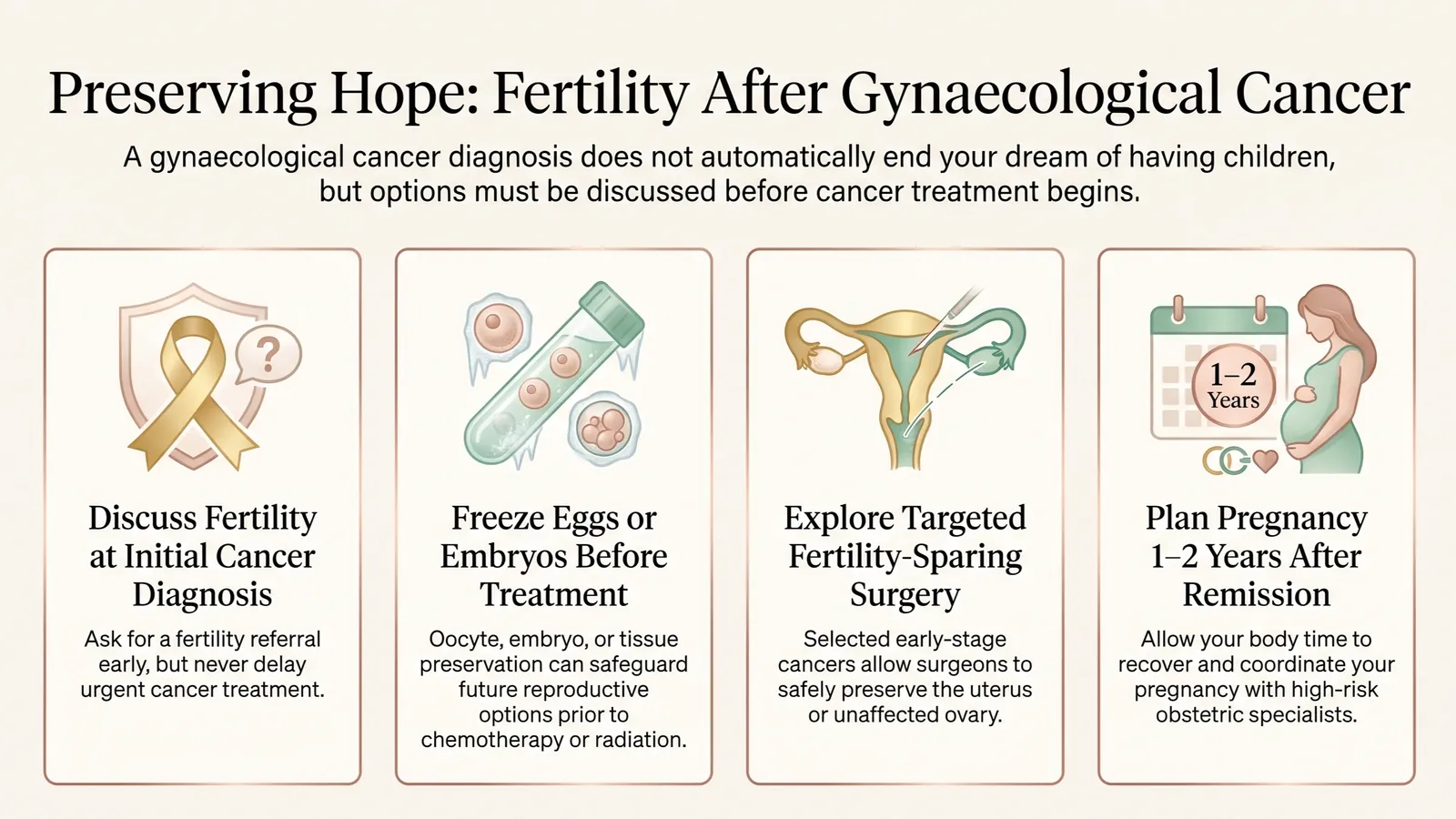
Four steps: talk about fertility early, consider freezing before treatment, ask about fertility-sparing surgery, and plan pregnancy with specialists once you have recovered.
"Ask about fertility early. Never let that question delay urgent cancer treatment."
What are the main fertility preservation options?
Professional guidelines describe these options in detail.[2] The main choices are:
- Egg freezing (oocyte cryopreservation): eggs are collected after ovarian stimulation and frozen for future use. It does not need a partner or donor sperm at the time.
- Embryo freezing: eggs are fertilised with sperm from a partner or donor, and the embryos are frozen. It needs the consent of both people and the legal rules on storage must be followed.
- Ovarian tissue freezing: a piece of ovarian tissue is removed through a small operation and frozen, to be returned later. It is offered at a limited number of centres, and is usually considered when there is no time for hormone stimulation.
- Ovarian transposition: before pelvic radiation, the surgeon can move the ovaries higher in the abdomen, out of the radiation field. Some ovarian function may still be lost, but the chance of keeping it is better.
- Hormone medicines to protect the ovaries: some teams use GnRH agonist injections during chemotherapy. The evidence for this is limited, and it is not a replacement for freezing eggs or embryos.
The right choice depends on your cancer, how soon treatment must start, your age and whether you have a partner. Your fertility team and your gynaecological oncologist should plan this together.
What is fertility-sparing surgery?
For a small number of early-stage cancers, the surgeon can remove the cancer and leave the uterus or an unaffected ovary in place. This is only safe when tests and the operation show that the cancer is confined and has not spread.
Cervical cancer
For very small, early cervical cancers, an operation called radical trachelectomy removes the cervix and the tissue around it but keeps the uterus, which may allow a pregnancy later. In a very early, carefully chosen cancer, some women may be treated with a cone biopsy (conization) alone. The choice depends on the staging of the disease.[3] A pregnancy after trachelectomy needs close monitoring, because the risk of miscarriage and preterm birth is higher than in an average pregnancy.
Ovarian cancer
Many women with early ovarian cancer that is confined to one ovary can keep the uterus and the other ovary. This can also apply to some borderline tumours and germ-cell tumours, which mostly affect younger women.[4] The surgeon must still examine the whole abdomen and take samples carefully, because the stage decides whether further treatment is needed.
Uterine (endometrial) cancer
For some very early, low-grade endometrial cancers, and for a precancerous change called atypical hyperplasia, hormone treatment with a progestin medicine may be used instead of a hysterectomy in a woman who wants to conceive. See our section on EIN for how this decision is made.[5] This needs a confirmed diagnosis, repeat biopsies every few months, and a clear agreement that the uterus will be removed once childbearing is complete. Not every woman is suitable, and the response varies from one woman to another.
Planning a pregnancy after treatment
Most teams advise waiting after treatment before trying to conceive, often about one to two years, so that any return of the cancer has a better chance of being found. The right timing depends on the cancer, the treatment and your personal risk.
Planning should involve your gynaecological oncologist and a high-risk obstetric team. Before you try, you may need tests of ovarian reserve, a scan of the uterus and a review of your medicines. If the cancer was sensitive to hormones, the fertility team may choose a stimulation approach that keeps oestrogen levels lower. This is decided case by case.
Trying to conceive during active treatment should be avoided, because many cancer medicines and radiation can harm a developing baby. Your team will advise on contraception until then. Women who had cervical surgery such as trachelectomy, or pelvic radiation, may need extra scans and checks during pregnancy.
Can I breastfeed after gynaecological cancer treatment?
Often, yes, but the timing depends on the medicines you received and on whether you are still taking any cancer medicine. Breastfeeding should not restart just because a set number of weeks has passed since your last chemotherapy.
Many women want to breastfeed, either because they are feeding a baby now or because they hope to after treatment. Breastfeeding is good for mother and baby, and cancer treatment does not rule it out for everyone. But some cancer medicines pass into breast milk and can harm a baby, so the decision must be made with your doctors, medicine by medicine.
Why does the type of treatment matter?
Being fit enough to become pregnant is not the same as being fit to breastfeed. A medicine may be safe for you but still reach your baby through your milk. Each type of treatment affects breastfeeding differently.
After surgery
Surgery for cervical, ovarian or uterine cancer does not automatically stop breastfeeding. If your breasts are making milk and you have recovered enough to feed your baby, you may be able to breastfeed again. The medicines used during anaesthesia pass into milk only in very small amounts. Guidance from the Association of Anaesthetists (UK and Ireland), published in 2026, says breastfeeding can resume once you are awake, alert and able to feed your baby. You do not need to express and throw away milk after anaesthesia.[6]
Some pain medicines still need checking. Repeated doses of certain opioids, in particular, should be reviewed by your anaesthetist or doctor before you breastfeed.
After chemotherapy
This needs the most careful planning. Most chemotherapy medicines can pass into breast milk, and they can harm a baby. Breastfeeding is generally not recommended during chemotherapy.[7] Our guide to chemotherapy side effects, diet and fever explains more about treatment days.
After the last dose there is no single waiting period that fits every medicine. The 2025 ASCO guideline on cancer during pregnancy advises a general safety window of about three weeks after the last chemotherapy dose. It also says that some drugs need a longer period and must be assessed one by one.[7]
Drug-by-drug information gives more detail. The US National Library of Medicine's LactMed database summarises what is known about medicines in breast milk. For example, the cyclophosphamide label says to wait one week after the last dose, yet some studies have found traces of the drug in milk for longer. Your team should check your exact medicines and dates.[8]
Platinum medicines such as carboplatin and cisplatin, and the drug doxorubicin, are especially hard to time. Platinum has been measured in breast milk for days or weeks after treatment, and the active breakdown product of doxorubicin can persist for a long time. There is no reliable general restart date for these medicines.[9][8]
Expressing milk does not remove medicines from your body. Milk made while a medicine is in your blood can carry that medicine with it. If your team asks you to pause breastfeeding, you may need to express and discard milk for a set time. Ask exactly how long, and whether you should keep expressing to protect your milk supply.
After radiotherapy
Radiation given to the pelvis from outside the body (external beam radiotherapy) does not make you or your breast milk radioactive, so it does not by itself stop breastfeeding. However, some radioactive medicines used in scans and treatment, such as radioactive iodine, do need a pause in breastfeeding. Your nuclear medicine team will tell you how long. Your recovery and your other medicines also need to be checked.
After hormone, targeted or immunotherapy
Some women continue medicines after chemotherapy to lower the risk of the cancer coming back. This is often called maintenance treatment, and these medicines can also pass into milk. Examples from the medicine labels include:
- Olaparib, a tablet used for some ovarian cancers: the label advises no breastfeeding during treatment and for one month after the last dose.[10]
- Pembrolizumab, an immunotherapy infusion: the label advises no breastfeeding during treatment and for four months after the last dose.[10]
These are examples, not a full list. Your oncologist should check the current label of every medicine you take, because advice can change as new information comes in.
What will your doctors check before you breastfeed again?
Before giving the go-ahead, your team will usually look at:
- Which chemotherapy and other medicines you received, and the exact date of your last dose.
- Whether you are still taking any medicine that passes into breast milk.
- How well you have recovered from surgery, radiotherapy or other treatment, and whether any problems are still ongoing.
- Your baby's age and health. A newborn or premature baby may need extra precautions.
- The painkillers, antibiotics and other medicines you take now. A medicine that is safe for you may not be suitable while you breastfeed.
Your oncologist may ask a clinical pharmacist, or a breastfeeding medicines service if one is available, to check each medicine against current drug information. Keep a written record of your treatment, with the names and dates of your medicines. It helps your team, and it matters if you ever change hospital (see Can You Change Hospital During Cancer Treatment? Keep Records on Track).
What if I have been expressing milk?
Some mothers keep expressing milk during treatment to protect their supply. Milk expressed while a medicine is in your body may contain that medicine, so it should not be given to your baby unless your team confirms it is safe. Do not assume that freezing, boiling or warming milk removes medicines. Ask your team:
- Should I keep expressing to protect my milk supply?
- Must milk expressed during treatment be thrown away, and for how long?
- When is milk expressed after treatment safe to give?
- Can milk that was stored earlier be used?
- What feeding plan is safest for my baby in the meantime?
Questions to ask your oncology team
- Which exact medicines did I receive, and when was my last dose?
- For each medicine, how long must I wait before breastfeeding, and what is that advice based on?
- Am I still taking any medicine that could pass into my breast milk?
- Should a clinical pharmacist check my medicines?
- Is my baby healthy enough to breastfeed, or are extra precautions needed?
- Can I have a written plan with the date I can safely breastfeed again?
Family members can help by writing these questions down before each appointment. Our family guide to caring for someone at home has more practical tips, and Life After Treatment answers other questions that come up once treatment is over.
"The end of chemotherapy does not automatically mean breastfeeding can restart. The safe date depends on the exact medicines you received."
Having had a gynaecological cancer does not automatically mean that you cannot breastfeed. Many women can, but only once the medicines, the time since the last dose, any ongoing treatment and your baby's health have been checked. Never restart breastfeeding based only on how many weeks have passed. Ask your team for a written plan.
What if my uterus has been removed?
A pregnancy cannot be carried in your own body after a hysterectomy. If eggs or embryos have been stored, gestational surrogacy, where another woman carries the pregnancy, may be an option.
In India, surrogacy is regulated by the Surrogacy (Regulation) Act, 2021, which sets strict rules about who may use it and on what terms.[11] The rules are specific, so ask your fertility team about current eligibility before you make plans. Uterus transplantation is still experimental and is offered only in a small number of research centres around the world.
Looking after your emotions
Worry about future children is a real loss, and many women carry it alongside the cancer itself. You do not have to make every decision on the day of diagnosis. Ask for counselling, bring a partner or a family member to appointments if you wish, and tell your team how important fertility is to you. Many centres have counsellors who work on both cancer and fertility concerns.
Questions to ask your team
- Is my cancer type and stage suitable for fertility-sparing treatment?
- Which fertility option is possible without delaying my treatment, and how long will it take?
- Will radiation or chemotherapy affect my ovaries, and should they be moved out of the radiation field?
- After treatment, how could I carry a pregnancy, and will a fertility specialist be involved?
- When is it safe to try for a pregnancy, and which tests do I need first?
Frequently Asked Questions
Can I still have children after cervical cancer?
Sometimes. For very small, early cervical cancers, surgery can sometimes keep the uterus so that a pregnancy is possible later. Radiation to the pelvis usually makes pregnancy impossible, so the options must be discussed before a treatment is chosen.
Do I have to freeze my eggs before cancer treatment?
Not always, but if you want that option, it must be discussed before treatment starts. Some treatments, such as radical surgery or pelvic radiation, can affect fertility. Egg or embryo freezing works best when there is time for it, and your team can say whether it is possible without delaying your treatment.
Will fertility treatment delay my cancer treatment?
It should not delay urgent cancer care. Freezing eggs or embryos usually takes about two weeks of hormone stimulation, and your team will weigh this against how urgent the cancer is. Some options, such as moving the ovaries before radiation, are done as part of the planned surgery.
Is pregnancy safe after endometrial cancer?
For some women it can be, if the cancer was early and low-grade and the treatment and follow-up were planned carefully. The timing, monitoring and choice of hormones must be decided by specialists, because the cancer can come back.
What is surrogacy, and is it legal in India?
Surrogacy means another woman carries the pregnancy. In India it is allowed only under the Surrogacy (Regulation) Act, 2021, which sets strict conditions on who may use it. Your fertility team can explain the current requirements.
References
- Oktay K, Harvey BE, Partridge AH, et al. Fertility Preservation in Patients With Cancer: ASCO Clinical Practice Guideline Update. Journal of Clinical Oncology. 2018;36(19):1994–2001.
- ESHRE Guideline Group on Female Fertility Preservation. ESHRE guideline: female fertility preservation. Human Reproduction Open. 2020.
- Bhatla N, Berek JS, Cuello Fredes M, et al. Revised FIGO staging for carcinoma of the cervix uteri. International Journal of Gynaecology and Obstetrics. 2019;145(1):129–135.
- Colombo N, Sessa C, du Bois A, et al. ESMO-ESGO consensus conference recommendations on ovarian cancer: pathways to care. Annals of Oncology. 2019;30(5):672–705.
- Concin N, Matias-Guiu X, Vergote I, et al. ESGO/ESTRO/ESP guidelines for the management of patients with endometrial carcinoma. International Journal of Gynecological Cancer. 2021;31(1):12–39.
- Mitchell J, et al. Guidelines for anaesthesia and sedation for patients who are breastfeeding: Guidelines from the Association of Anaesthetists. Anaesthesia. 2026;81:685–701.
- Loren AW, Lacchetti C, Amant F, et al. Management of Cancer During Pregnancy: ASCO Guideline. Journal of Clinical Oncology. Published online 11 December 2025.
- US National Library of Medicine. Drugs and Lactation Database (LactMed), entries for cyclophosphamide and doxorubicin. National Institute of Child Health and Human Development.
- Damoiseaux et al. Presence of Five Chemotherapeutic Drugs in Breast Milk as a Guide for the Safe Use of Chemotherapy During Breastfeeding: Results From a Case Series. Clinical Pharmacology & Therapeutics. 2022.
- US Food and Drug Administration. Prescribing information: Lynparza (olaparib) and Keytruda (pembrolizumab).
- Government of India. The Surrogacy (Regulation) Act, 2021.
Related Reading

Worried about your future fertility?
Dr. Dipanwita Banerjee offers consultations at CNCI Kolkata to plan cancer treatment together with fertility options where they are suitable.