
Diagnostic steps for fibroids and uterine cancer.
Most growths in the uterus, including fibroids, are not cancer. A fibroid is a non-cancerous growth of the uterine muscle. A rare cancer called leiomyosarcoma can look like a fibroid, so bleeding after menopause, or an unclear scan finding, always needs proper investigation.[1]
Is a fibroid cancer?
No. A fibroid, also called a leiomyoma, is a non-cancerous growth from the muscle wall of the uterus.
Fibroids vary in number and size. Many cause no symptoms. Others can cause heavy periods, pelvic pressure or pain.
Uterine sarcoma is a different condition. The National Cancer Institute describes it as a very rare cancer that forms in the muscle of the uterus or in the tissues that support it.[2] It is not the same as endometrial cancer, which starts in the lining of the uterus.
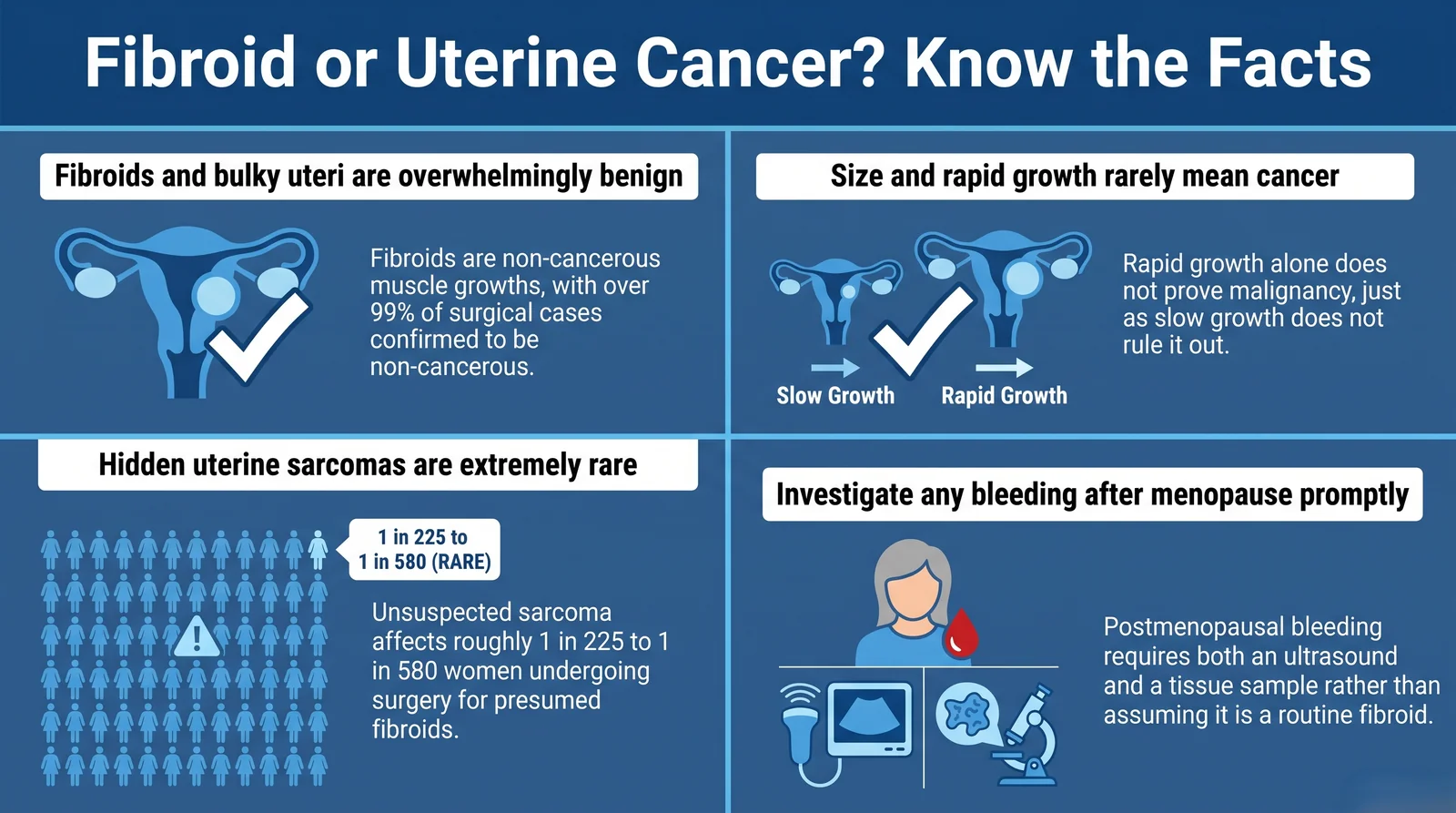
Does a bulky uterus or fast growth mean cancer?
No. A bulky or enlarged uterus describes size, not a diagnosis. Fibroids, adenomyosis and other common conditions can all make the uterus larger. Size alone does not show cancer, although a small mass may still need investigation because of how it looks or the symptoms it causes.
Rapid growth alone does not prove cancer, and slow growth does not rule it out. Your doctor will look at the whole picture: your age, menopausal status, symptoms and scan report.
How rare is a hidden sarcoma?
A hidden (unsuspected) sarcoma is rare but possible. Published reviews of surgical series estimate that about 1 in 225 to 1 in 580 women having surgery for presumed fibroids has a hidden uterine sarcoma.[1] For leiomyosarcoma specifically, the estimate is about 1 in 495 to 1 in 1,100.
In other words, more than 99 in 100 women having surgery for presumed fibroids do not have a hidden sarcoma. There is currently no reliable way to tell, before surgery, whether a fibroid is a sarcoma.[1]
Bleeding after menopause needs prompt checking
Bleeding that starts 12 months or more after your last period is called postmenopausal bleeding. Not all of it is cancer, but all of it needs to be checked. About 90% of women diagnosed with endometrial cancer have had this symptom beforehand.[3]
In April 2026, the American College of Obstetricians and Gynecologists updated its guidance. For most women with postmenopausal bleeding, a transvaginal ultrasound and a sample of the uterine lining (endometrial biopsy) are now recommended together at the first evaluation. Ultrasound alone can miss some cancers.[3]
"Do not assume that bleeding after menopause is caused by a known fibroid."
The National Cancer Institute lists these as possible signs of uterine sarcoma. Each one can also have other causes.[4]
- Bleeding that is not part of a period
- Bleeding after menopause
- A mass in the vagina
- Pain or fullness in the abdomen
- Frequent urination
Scans and tests
Ultrasound is usually the first test for a suspected fibroid or an enlarged uterus. When the findings are unclear and MRI is available, an MRI scan can give more detail. A 2023 consensus statement by radiologists sets out common terms and an MRI approach for assessing uterine masses that might be leiomyosarcoma.[5] Even so, imaging cannot always give a definite answer, and examination of tissue under a microscope is often needed. The tests and treatments available vary between hospitals, so ask your doctor what is available to you.
Before surgery, ask about morcellation
Morcellation cuts tissue into smaller pieces so that it can be removed through a small incision. If a hidden cancer is present, cutting it this way can spread cancer tissue within the abdomen and pelvis.[1] International safety advice is that power morcellation should be used only in carefully selected women, and only with a tissue containment system. It should be avoided in women with suspected or confirmed cancer. The risk of hidden cancer also rises with age.[1]
Ask your surgeon how the tissue will be removed, whether a containment system will be used, and what the plan is if cancer is found.
When to see a doctor
Arrange a gynaecological assessment promptly if you have:
- any vaginal bleeding after menopause, even light spotting
- new or persistent pelvic or abdominal pain
- increasing abdominal fullness or pressure
- a uterine mass that appears to be growing after menopause
- an ultrasound report that describes a mass as atypical, uncertain or suspicious
Sudden severe pain, fainting, marked weakness or heavy bleeding needs urgent medical care.
Frequently Asked Questions
Can a fibroid turn into cancer?
A fibroid is not a cancer, and an ordinary fibroid is not generally considered to turn into one. The real concern is a rare cancer, such as leiomyosarcoma, that can be mistaken for a fibroid before surgery.
Does a normal ultrasound rule out cancer?
Not always. This matters especially after menopause. Even when an ultrasound looks normal, bleeding after menopause still needs further assessment.
Do all fibroids need surgery?
No. Many fibroids need no treatment. The right choice depends on your symptoms, the size and position of the fibroid, your age and the reason for concern.
Should I wait to see whether a fibroid grows?
No. Seek advice based on your symptoms and scan report, not growth alone. Bleeding after menopause, persistent pain or an unclear scan finding should be discussed with a doctor now.
References
- U.S. Food and Drug Administration. Power Morcellation During Gynecologic Laparoscopic Surgeries. Content current as of August 20, 2026. https://www.fda.gov/medical-devices/surgery-devices/power-morcellation-during-gynecologic-laparoscopic-surgeries
- National Cancer Institute. What Is Uterine Sarcoma? https://www.cancer.gov/types/uterine/sarcoma
- American College of Obstetricians and Gynecologists. Updated Guidance Regarding the Role of Transvaginal Ultrasonography in Evaluating the Endometrium of Individuals With Postmenopausal Bleeding. Clinical Practice Update. Obstetrics and Gynecology, April 2026.
- National Cancer Institute. Symptoms of Uterine Sarcoma. https://www.cancer.gov/types/uterine/sarcoma/symptoms
- Hindman N, Kang S, Fournier L, Lakhman Y, Nougaret S, Reinhold C, et al. MRI Evaluation of Uterine Masses for Risk of Leiomyosarcoma: A Consensus Statement. Radiology. 2023;306(2):e211658.
Related Reading

Have a uterine scan report to discuss?
Speak with Dr. Dipanwita Banerjee about your report and the next steps.