
A uterine biopsy report is often the first time a family reads words such as "serous", "grade 3" or "carcinosarcoma" in writing. Each word answers a different question. This guide explains them in plain language so you can prepare for your conversation with your doctor. It does not replace that conversation, and the words alone cannot tell you your own outcome.
What does a uterine biopsy test?
A uterine (endometrial) biopsy takes a small sample of the lining of the womb. A pathologist, a doctor who specialises in examining tissue under a microscope, reads the sample and writes the report.
The report gives the tissue diagnosis. It may describe a normal lining, a non-cancerous change such as a polyp or hyperplasia, or cancer.[1] If the sample is too small or too damaged to read, the report may say the result is insufficient, and a repeat test is usually needed.
A biopsy is a sample, not the whole organ. Your doctor will read it together with your examination, your scans and, if surgery is done, the removed uterus.
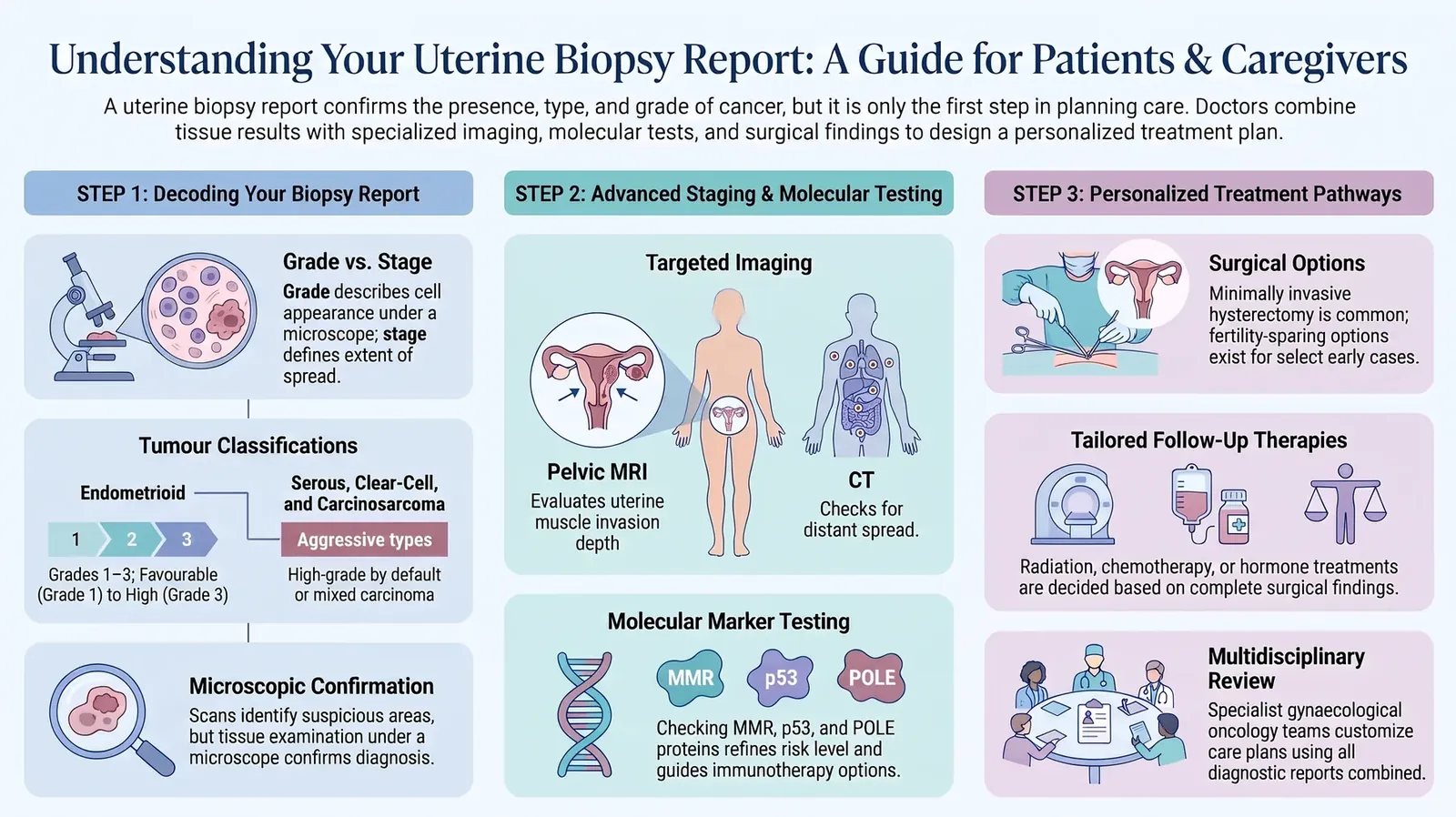
What do the tumour type words mean?
The type names the kind of cancer cell. Most uterine cancers are endometrioid. Serous, clear-cell and carcinosarcoma are less common, and they usually behave more aggressively.
- Endometrioid carcinoma: the most common type, arising from cells that resemble the lining of the womb. This is the type that is graded from 1 to 3.
- Serous carcinoma: a less common, more aggressive type. It behaves more like some ovarian and tubal cancers.
- Clear-cell carcinoma: a rare type whose cells look pale or clear under the microscope. It is also aggressive.
- Carcinosarcoma: a rare type containing both carcinoma (cancer of the lining-type cells) and sarcoma-like (connective tissue) parts. It is managed by a gynaecological oncology team.
What does grade mean on the report?
Grade describes how abnormal the cancer cells look and how they are arranged. For endometrioid cancer it is scored from 1 to 3. Serous, clear-cell and carcinosarcoma are high-grade by their type, so they are not given a 1 to 3 score in the same way.
For endometrioid cancer, the pathologist estimates how much of the tumour grows as solid sheets rather than in gland-like patterns.[1]
- Grade 1: less than 5% solid growth. Usually the most favourable.
- Grade 2: 6% to 50% solid growth.
- Grade 3: more than 50% solid growth. It behaves more aggressively than grades 1 and 2.
A higher grade means the cells look more abnormal. It is one factor among several, and on its own it does not decide the treatment or the outlook.
How is grade different from stage?
Grade describes the cancer cells. Stage describes how far the cancer has spread, such as into the muscle wall of the uterus, the cervix, the lymph nodes or other organs. The biopsy gives the type and grade. The stage is usually completed after imaging and surgery, when the uterus and sometimes nearby lymph nodes have been examined.[2]
What are MMR, p53 and POLE?
These are molecular tests on the tumour tissue. They help sort endometrial cancers into groups with different outlooks and treatment options. Your doctor may call this the molecular classification.
Under the 2023 FIGO staging system, endometrial cancers are grouped by four molecular features:[2]
- POLE mutation: a change in a gene involved in DNA repair. It is usually linked with a favourable outlook.
- Mismatch repair deficiency (MMR-d): some of the cell's repair proteins are missing. This can influence treatment choices, including immunotherapy in some advanced or recurrent cancers.
- p53 abnormal: a change in the p53 protein, which is seen more often in serous and other aggressive types.
- No specific molecular profile (NSMP): none of the three features above. This is a large group.
MMR is usually tested by staining the tissue sample (immunohistochemistry). POLE testing uses gene sequencing. Some results can take extra time, so the report may arrive in parts.
How do the scans and surgery fit in?
Pelvic MRI is commonly used to see how deeply the cancer has grown into the wall of the uterus. CT or other imaging looks for spread to other organs.[3] In many cases, surgery to remove the uterus, the tubes and the ovaries, with assessment of lymph nodes where indicated, gives the final stage and guides any further treatment, such as radiation, chemotherapy or hormone therapy.
Minimally invasive and robotic surgery are options for many patients. For a small number of younger women with early, low-grade endometrioid cancer or atypical hyperplasia who wish to keep their fertility, ESGO guidelines describe hormone-based treatment under close specialist supervision.[4] This is a decision to be made with a specialist, not something to start without a doctor.
Questions to take to your doctor
- What is the exact tumour type, and what does the grade mean for my case?
- Were MMR, p53 and POLE tests done, and what do the results mean for my treatment?
- Do I need an MRI or CT scan before a treatment plan is made?
- Can another pathologist review the slides, or can my case be discussed by a multidisciplinary team?
- Which specialist will manage my treatment, and how soon?
Bleeding after menopause always needs prompt medical assessment, whatever the final report says. A biopsy report is one step in a plan that your doctor builds with you.
Frequently Asked Questions
Does a high grade mean the cancer cannot be treated?
No. Grade is one of several factors, along with tumour type, stage, molecular features and your general health. Your specialist will explain how it fits into your own plan.
Is carcinosarcoma the same as sarcoma?
Not quite. Carcinosarcoma is a rare uterine cancer that contains both a carcinoma part and a sarcoma-like part. It is managed by a gynaecological oncology team, who plan treatment for the whole tumour.
Can I get a second opinion on my biopsy report?
Yes. You can ask for the slides to be reviewed by another pathologist, or for the case to be discussed at a multidisciplinary team meeting. Our article on changing hospital and keeping records explains how to take your reports to another doctor.
Does a benign result mean follow-up can stop?
A benign report is reassuring, but follow-up should continue if bleeding carries on. If the report mentions atypical hyperplasia, meaning changes that can develop into cancer, it needs specialist review and a clear plan.
References
- WHO Classification of Tumours Editorial Board. Female Genital Tumours. WHO Classification of Tumours, 5th edition, Volume 4. IARC Press, Lyon; 2020.
- Berek JS, Matias-Guiu X, Creutzberg C, et al. FIGO staging of endometrial cancer: 2023. International Journal of Gynaecology and Obstetrics. 2023;162(2):383–394.
- National Comprehensive Cancer Network. NCCN Clinical Practice Guidelines in Oncology: Uterine Neoplasms. Current version. NCCN.
- Concin N, Matias-Guiu X, Cibula D, et al. ESGO/ESTRO/ESP guidelines for the management of patients with endometrial carcinoma. International Journal of Gynecological Cancer. 2021;31(1):12–39.
Related Reading

Want your biopsy report reviewed?
Bring the report to a consultation with Dr. Banerjee, who will read it alongside your examination and scans.